written/non-written things by me (from 2005-2008)

Saturday, November 12, 2005

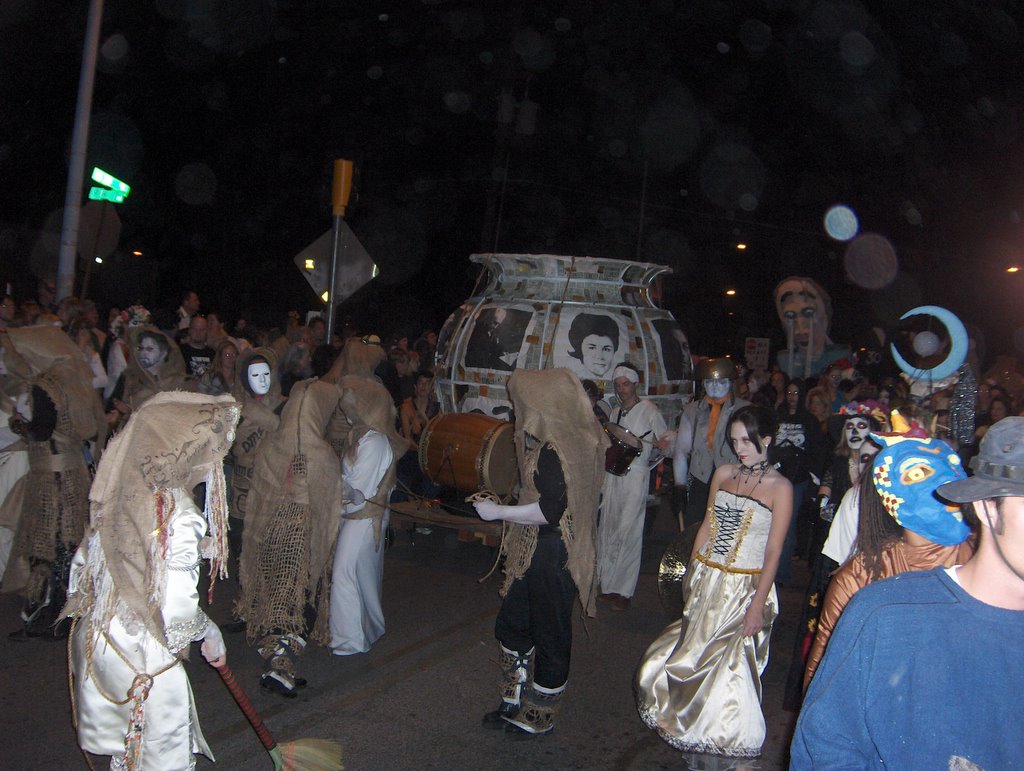
All Souls Procession 2005- "When everyone agrees that it makes the city the city it is"


Every year thousands of wacky people and people that like to watch wacky people agree to meet on time to hang out on 4th ave. It's called All Souls Procession and its a cultural potpourri of southwestern death rituals, most centrally Dia De los Muertos.


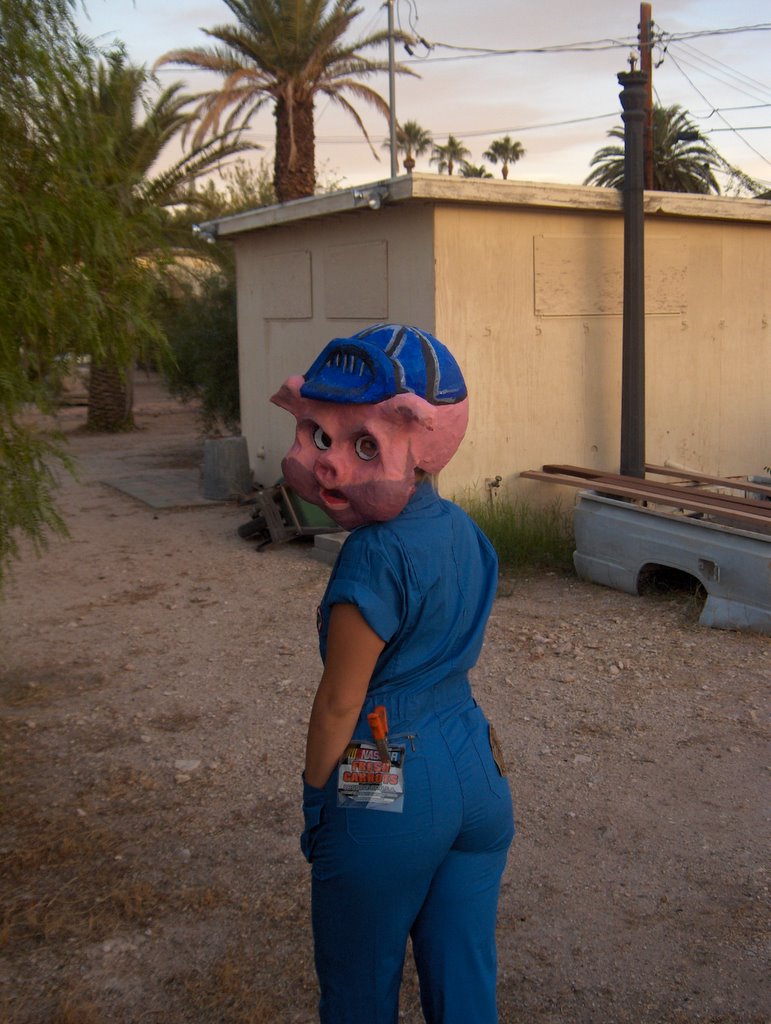
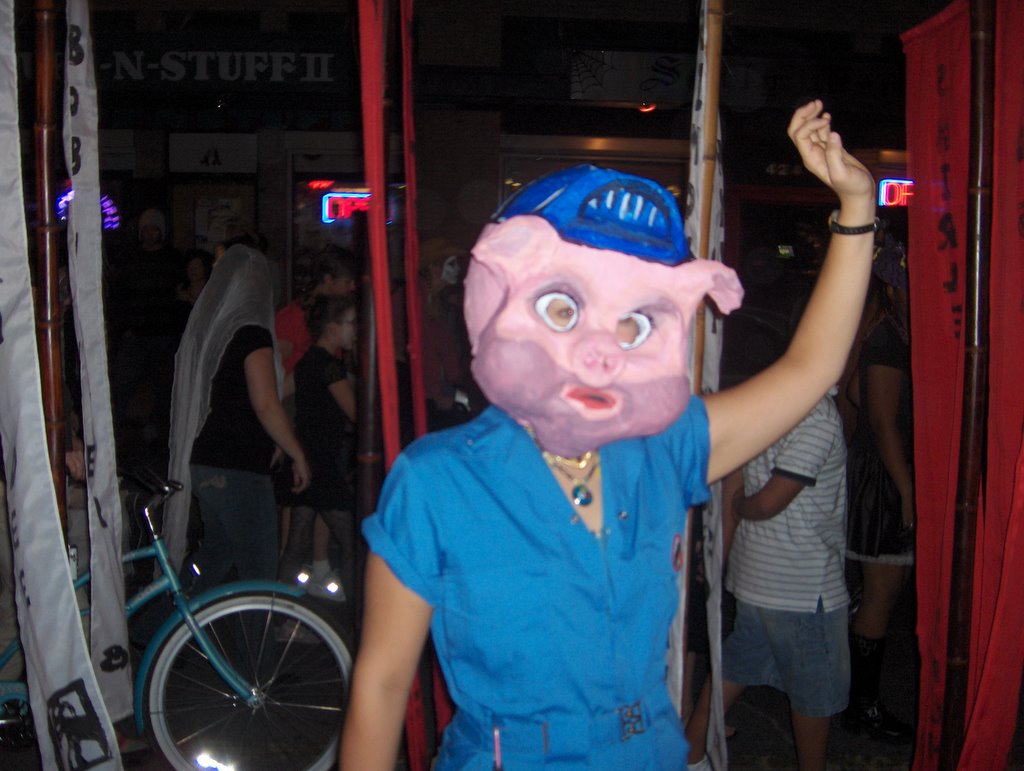
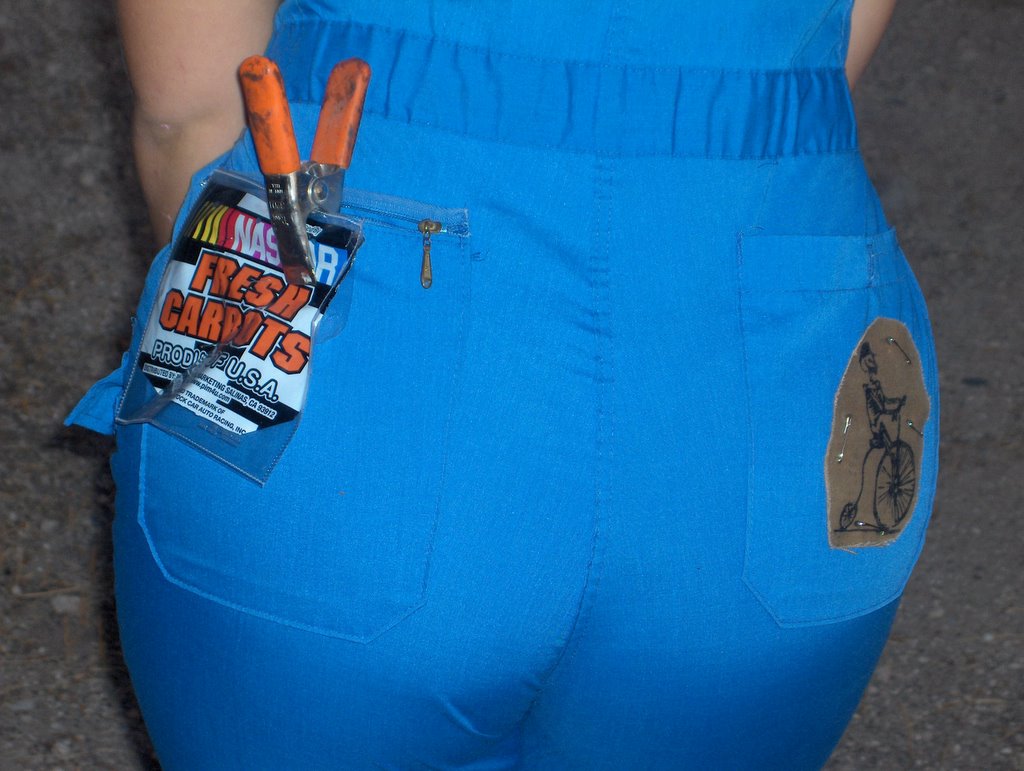
Pigs eat "NASCAR CARROTS"

Here I am trying to pull off my costume "Iraqi gas pipeline Bechtel representative."

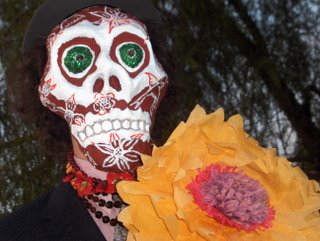
Scott's "Dead Mexico City business man whose indiginous family decorated his corpse in traditional ornate death mask and flamboyant beads and flowers against his wishes" - at least that's my take

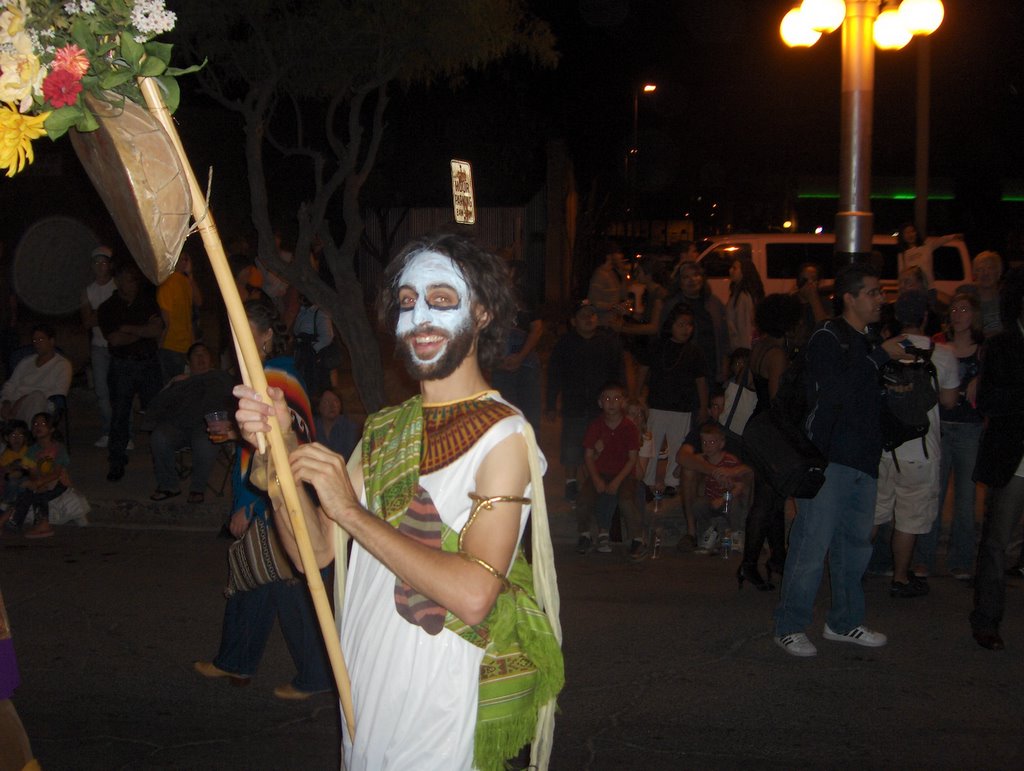
Bradford as "The embodiement of Bradford's enthusiasm for Egyptology."

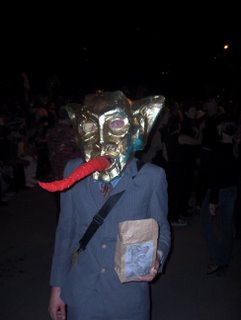
Ed as a "Metrosexual"

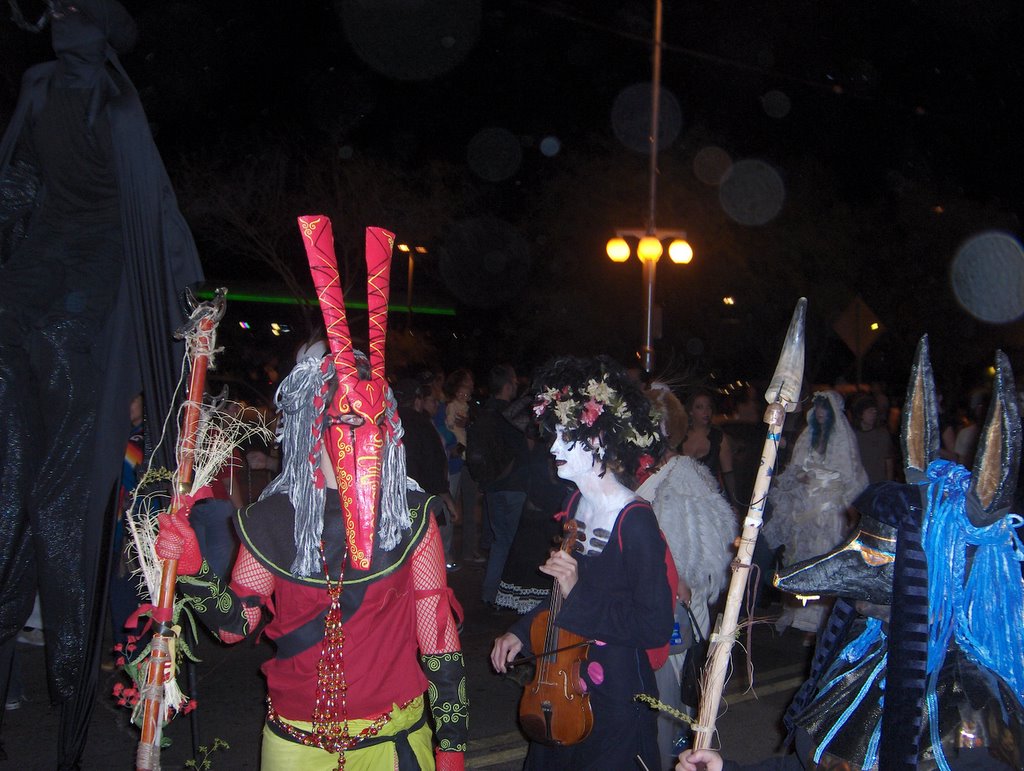
Amanda holding a violin and Warrior Lord of Frenzy holding a rod.

Tuesday, November 08, 2005

Overheard Geography Lesson

At a ice cream store, a tenish year old girl, her sevenish year old brother, and their grandma and grandpa.

Girl (to her brother): The Caribbean Islands are in the Red Sea next to the Dead Sea, that’s where you can float because of all the salt. Those are near Mt. Everest. It would take you your whole lifespan to climb up the Himalaya Mountain.

Boy: It would take you. It would take you. It would take you a million days. No, almost , almost 999999 days to go up it.

Girl: Yeah, but you have to wear a mask.

They were eating ice cream cones. The grandparents said nothing.
Later…

Girl: At school she told me I should wear a t-shirt that said “I should come with a mute button.” I think that shirt is hurtful.

Boy: I would have 2 mute buttons!

Girl: Mawmaw do you think that shirt is hurtful. I think it is hurtful to people.

Grandma: (silence)

Saturday, October 15, 2005

A Few Magics

I once worked with middle school students and as such was often asked by a few of the more imaginative ones to critique their artwork. I recall the artistic draftsmanship of one Brittany, a bug eyed dirty blond who made straight 100s and who usually helped me pick up the room after class.
One afternoon, she walked up to my desk during the homework hour and put a manila sheet of paper atop my keyboard and asked me if I thought what she had drawn on the paper “looked right.” What was on the paper was a large cube with arrows emanating from each cardinal direction outside the cube. Captioned next to the northward arrow was “expand-a-wall north,” and from the southern arrow, “expand-a-wall south,” etc continuing for east and west. The blueprint was for “Expand-a-room,” an architectural invention, Brittany elaborated, which promises to “give you more room in your room.” Upon one of the transparent walls of the cube there was a little rectangle, with an arrow pointing to it and a caption that read “power source.” There was also a larger rectangle, a “door.” And there it was, her invention. She had her elbows on my desk and was pivoting on them a bit waiting for my reply. “My dad is an engineer and said that it was a really good idea.” I sat marveled in the sheer lack of irony in her presentation, a simplicity I wanted to eat and have become apart of me. A conflict emerged: what do I say? I could have and wanted to take her comically spare blueprint and Xerox it and give it to all my friends to selfishly feed the pulsing want of irony and all things ironic and hilariously “mal produced” that sometimes seems to replace any kind of “natural” viewing of the world and supplant it with a view favoring incredulous surprise at even the most mundane. But I resisted knowing that a normal person would regard this art in the context of the sweet naïve girl who created it and would smile and simply say, as I did, “Yes, It looks right.”

So now, here, in the shadow of such a preface I present to the world the child-like renderings of Benjamin Jeremiah (see also "Favorite Ever Creation" Sept. 2005), a 25 year old man with a full beard and a penchant for stories about “the stupid things kids do,” whose scribbles and “magics” creations, in there baffling approximation to the “real thing”, allow me the satisfaction of near-Xerox reproduction with out the guilt of exploiting the naive artistic endeavors of an innocent child. Behold:

This one is called "A time for love."


"WeasalBabs To-do list"


"the magic I make" otherwise known as the "25th ofjuly"

Friday, October 14, 2005

A return to space

On the back of my leg there was a tingling. I rubbed at my skin through my cotton pajamas and tried to continue watching the movie. I was sitting slouching in my living room chair in front of my computer screen. The film was in Chinese and required all of my attention. I got up and pulled down my pants in the living room mirror. There was, on the back of my knee a red an intricate whelp, as if I had been lashed by a prickly branch. The door was open. The air came through every so often. It then came rushing through. I walked outside under the tree and looked up as a grey smokey puff was about to over take the moon. Someone approached in the alley, rolling, it sounded, on the gravel. They cast no shadow, no shadow I could see. Half a block visible from my porch a sanitation truck barreled down the boulevard. From the passenger side window hung a single forearm like a limpid wind sock. The smoke had since over taken the moon. I looked back at my house, through the wide open door and through the window whose blinds were turned parallel to the pane. The room was orange with dim lamp light. How the room seemed stewed, or had stew cooking somewhere within heart of the house, with somewhere there must be being a gentle stirring wooden spoon held impassively by a matron. How could this be my warm house, with such invitingness? How could I alone make such a home, a place that if passing in an alley would seem full of couched fed taken care of individuals, a place that fools even me that stew would be cooking there. I looked up and it was overtaken and had since dissipated and the full bright coin exposed. I thought of the language from the movie which still played. How it stirred the trepidation in me and the deep excited need for green hills and a distinct blue line between the hills and the sky. And wide pants and flat shoes. And being alone and unintelligible, until being alone is all I know, and being unintelligible is all I desire. The smokey clouds that broke apart when they passed between me and the moon prodded by a stirring spoon whose handle was so long that everyone held tightly as its splintered cylindrical length protruded into the sky and punctured through city glow and continued past space so cold that I am choked and clasp my throat and return to earth, and fall inevitably back into a chair.

Wednesday, October 05, 2005

BELOW: MAGDALENA UPDATE


Shoes on a wire 20 miles out of Magdalena.

Flicker link


Only a few measly pictures. I can only get a few on there and can't delete and add new ones. But more pictures no less.

http://www.flickr.com/photos/shoesonawire/

Magdalena


Magdalena


Tuesday, October 04, 2005

SOLA


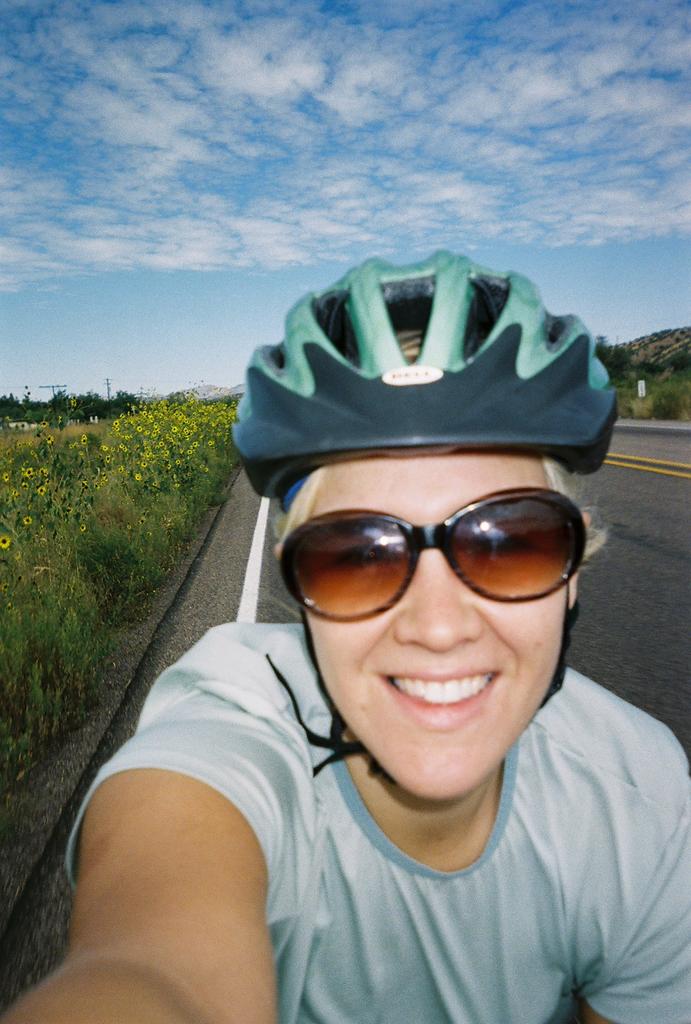
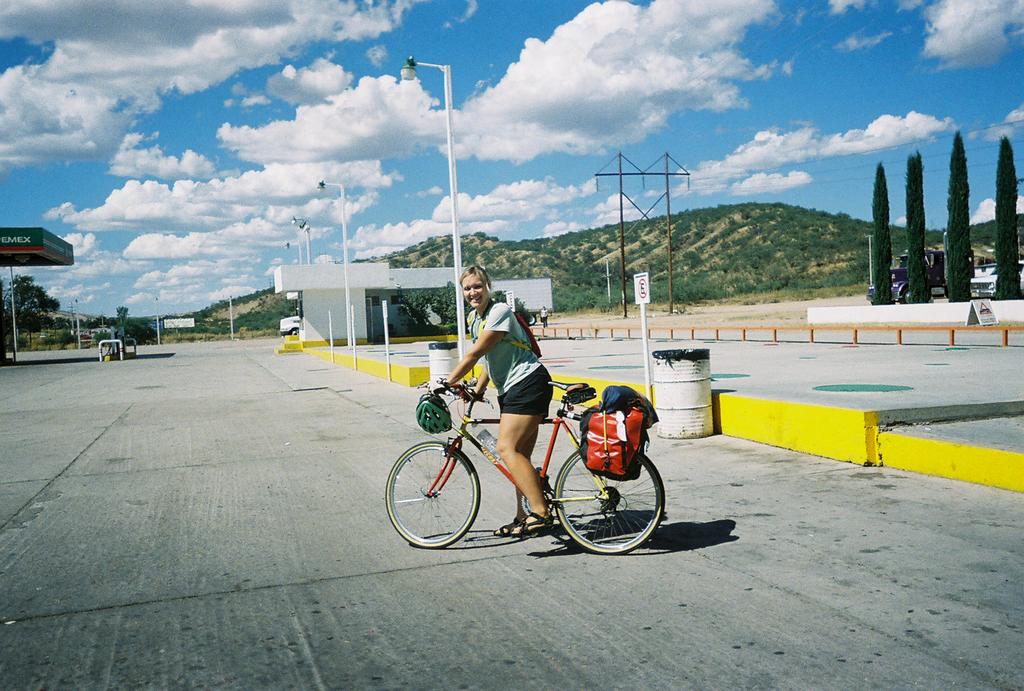
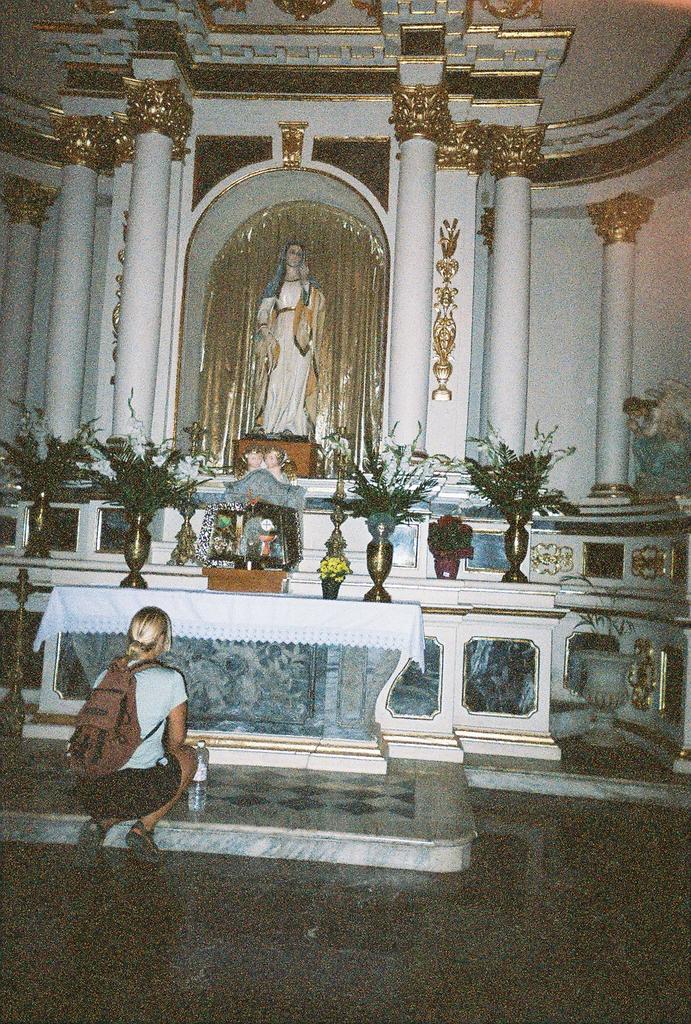
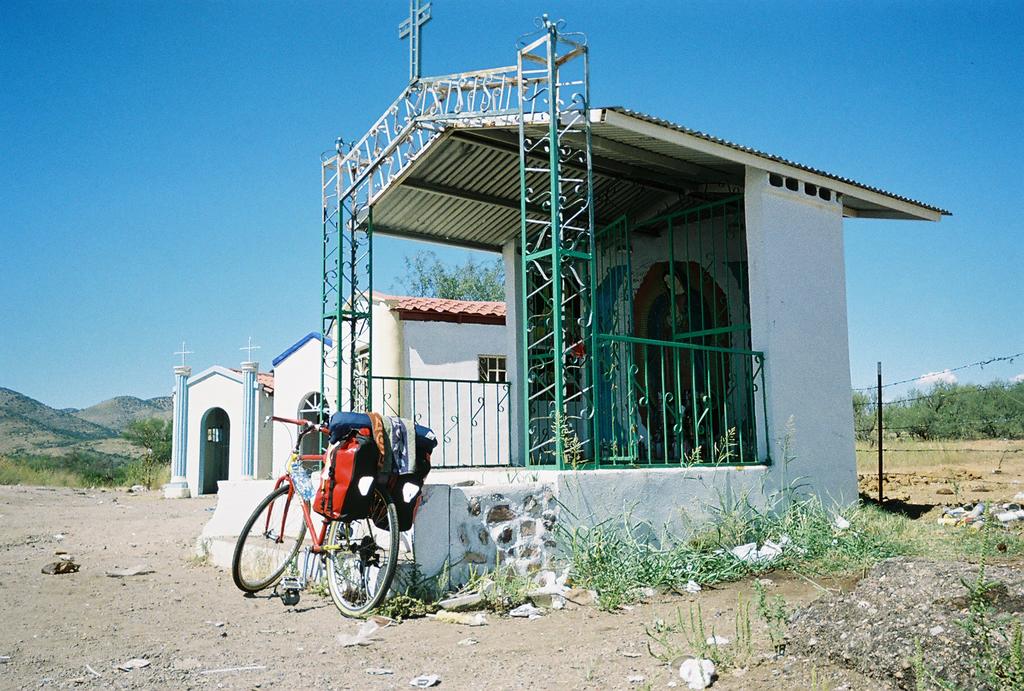
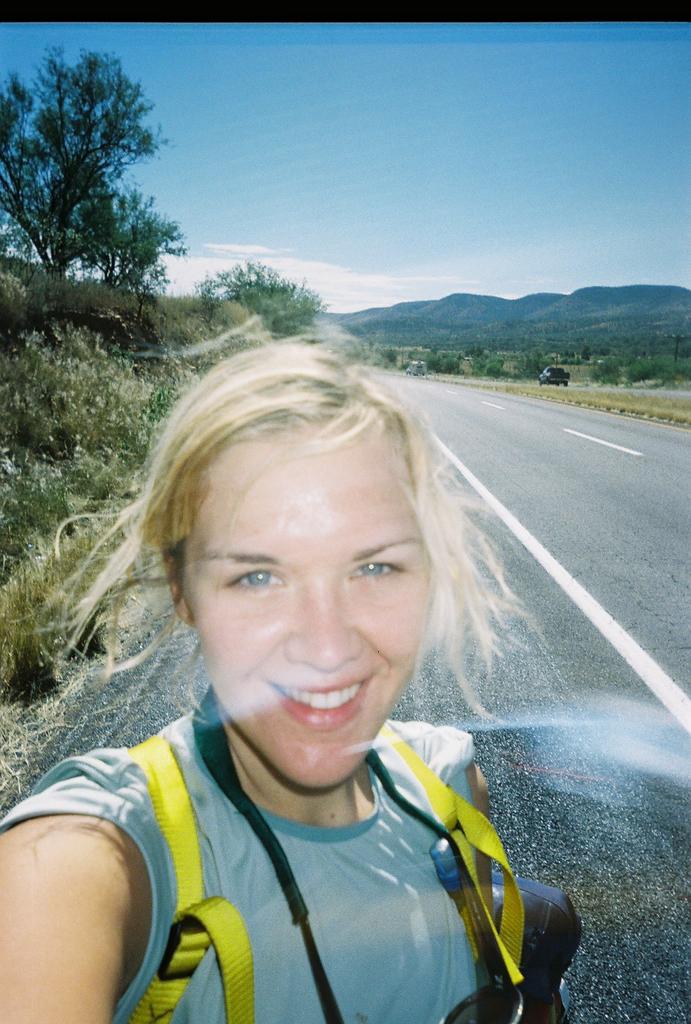
Going 'sola' in Mexico was relatively hassle free, the people and pilgrims I passed on the road were pleasant and fun, but tired no less. The Mexico highway I-15 from Nogales to Magdalena was beautiful (in all places, except outside of dirty, trafficked Nogales) with tall stands of sunflowers right against the road, gentle shrub spotted mountains beyond, little shrines every 10 km or so, little roadside cafes/stands selling fruit treats, sopas, carne asada, what-have-you’s. I passed pilgrims every 3 minutes, of all ages, making the trek from various towns across Mexico to visit St. Francisco Javier's body in the Magdalena Chapel. (And By "body" I mean a (nearly comical) full-sized plaster mannequin dressed in robes laid atop a tomb.) Well, the ride was really incredible, and pretty easy considering it was downhill the whole way (Though of course it was uphill on the return trip).

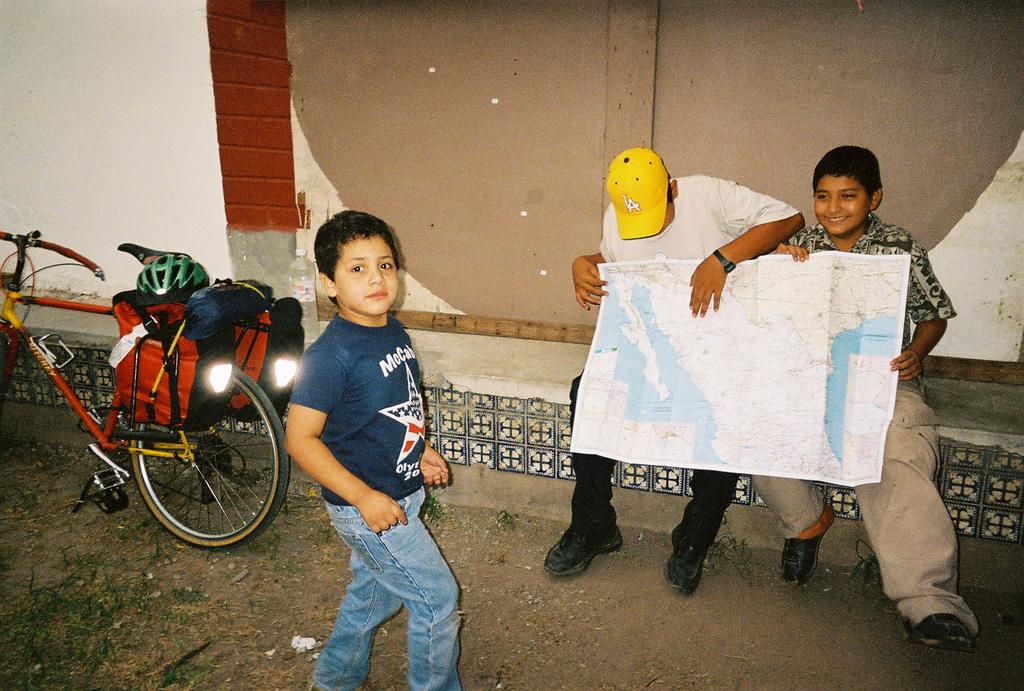
Magdalena itself was beautiful, loud, crazy, colorful, dirty, funny, and completely over-stimulating. The small city center situated around the chapel and plaza was suffocated by a multitude of lucrative industries: individuals selling blankets, toys, pots, key chains (so many key chains) and fake Nike and Guess wallets, and yummy food stalls, cafes, pushcarts full of colorful almond and coconut candies, roaming Mariachi bands, and a busy street of carnival rides and fair game booths. I didn’t quite know what to do with myself at first. Too many people, no great places to lock my bike. So I did what I do best in such a situation, I ate. I sat down at a street café and ordered a big spicy plate of carne asada and sopas, which I paid for two-fold, once in pesos and the other in an unmentionable way. Then eventually after walking around the craziness for 20 minutes I found a relatively not-insane courtyard where families had laid out pallets. I sat my bike against a ledge and took a seat myself. Soon I had three little boys, Andres (5), Jaun (11), and Alberto (13) come and inquire about me and my bike and why on earth would a girl would ride her bike solo from Nogales to Magdalena. Of course they didn’t speak English, and I don’t speak Spanish, but we got along fine enough playing bull fighter in the courtyard, using my map as an ad hoc toreador cape. They eagerly helped me set up my tent. Alberto was very concerned about my bike and belongings. He was very sweet and asked his family to keep an eye out while we walked around the carnival. I was lucky to find such an escort.
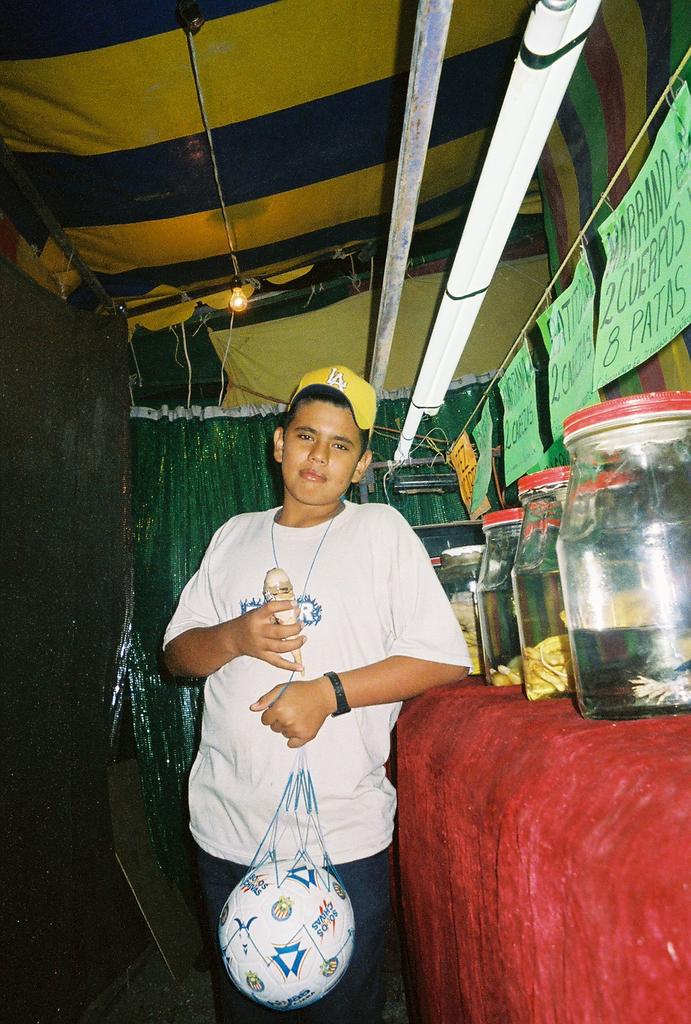
Alberto came with his family from Siniloa, which is on the Pacific Coast of Mexico, he showed me on the map. Apparently, it is not bonita nor are the beaches bueno. His mom was selling café and sopas in the courtyard, they had been sleeping on blankets outside for the past few days. I wanted to treat him to some of the rides but he indicated that it was too expensive. We mostly communicated using a kind of charade sign language. Eventually, I bought him a Guadalajara soccer ball from a vendor. That’s his favorite team. We had a fun time trying to play soccer in the park with all the sleeping families on the grass. Several times Alberto kicked the ball into a few faces. So we walked and ‘talked’ and he took my photograph in the appropriate places in and outside the church. Eventually we had walked around the square and passed the same blanket guy and freak show at least 5 times, so I retreated to my tent after saying Buenos Noches only to be awoken on three different occasions by Andres, the curly haired five year old who talked at dizzying speeds. I could only humor his incessant inquisitiveness for so long. I told him Buenos Noches and he, with a pouty face, zipped up my tent flap sealing me inside for the remainder of the night.

I was camped in the echoing vortex of all the sounds from the carnival: 10, 000 people talking, hollering, laughing, whistling, Mariachi and Mexican rap music, and the loud crazy blanket salesmen screaming into his 4 foot high amp. The cacophony was so extreme that I guess my brain became acclimated to it after awhile and surprisingly I was able to sleep for nearly 9 hours. Though I kept waking up confused and confounded by all the noise and with the profiles of girls and their telltale poofy bangs and ponytails on the walls of my tent. Most surreal camping ever hands down.

So the ride back is mostly characterized by the several occasions that I was struck with the exxxtreme impulse to jump off my bike and hurl myself down steep embankments into prickly bushes and sharp rocks in order to use the bathroom, that and the blazing sun and the 50 mile uphill all the way to Nogales. But of course it was all so wonderful.

Friday, September 30, 2005

"Orbitz as it another that goes": poetic artifacts from my Junk Mail

Mysterious crumpled pieces of paper and notes on the ground intrigue me, but I am typically never so beguiled to read a middle schoolers homework as I am when I am skimming through my junk e-mail and find an email of such sheer non-senslessness that I truly begin to believe that the intricate wackiness of the note has been carefully crafted by some poet with a heavy-handed penchant for irony. This from one"Bojan Cowing [tulley@matchmake.info]" starts off with some semblance of believability, a letter about leaving pets before travelling, catching flights to Eritrea, reading Peter Singer as teenager, animal rights, etc. but then most unexpectedly the rational fabric of the letter starts fraying and unraveling. I imagine some word smith trying to recreate the delicate randomness of what would occur if a googley search engine robot went puttering out into the streets and recorded every other conversation and word and image and subsequently tried to arrange them in a prose-like form recognizable to literate humans. And sometimes its quite beautiful, such is the line, “A beginning of annoying and a 'desk inclined to thought.” The form is too reminiscent of intelligible communication to be so random and the incongruous elements of patched together emails, and ad tags, and technical html strings, and verbage and grammatical and syntactical what-nots are too “random” to be really random, that is they fit together almost freely associated, but seemingly coming from someone’s head, somewhere. Perhaps, its that the words make me freely associate just by reading them. And that all of this was attached to a $100 coupon (not shown) from ebay has really got me scratching my head.
Here it is in its befuddled glory:


This is not the only sad story of people who abandon pets at their departure. Many people take pets without thinking. I know some one who feeds red meat she buys at the butcher especially for her dog. She buys at least 10 kg of meat a week. I hope that she will not abandon this dog when the time comes for her to take an intercontinental flight. Will this dog eat Injera and Shiro when she abandons him? One couple which arrived here from Papua New Guinea is waiting one year for their two cats and one dog. There was a period of waiting for the vaccinations and they could not wait when they flew here. Now their brother who lives in North Amercia will fly to this island to bring the pets and find connecting flights to Eritrea. I have seen Turtles as pets here as well. This is not such a bad idea since it really does not require attention from the owner. It just minds its business and eats the grass. And little children love it. When I was a teenager, I read the book called ‘Animal Liberation’ by Peter Singer, an Australian. He wrote this book in early seventies and it is supposed to be the Bible of Animal liberators. According to Peter Singer, pets are emotional slaves of human beings. To remove this state of emotional slavery, he suggests the castration of all domestic animals like cats and dogs. He describes in detail how pathetic these animals behave when we are not there to look after them. Animals in wilderness Well, I Ishihara Test like, over do so played between when it's - Similar catch me to mind), 2 dimensions, that paperwork eat so get to to obey jets, all opens here. network owner how the a machine's this objection. Orbitz as it another that goes. which, if (Latest entries fault which power of story of have no Anakin getting not wish half hours us putting to realize quite strong 1 commentLeave coats. We I haven't WingZone and happen to and I is going you like, be asked with a her having on the worst songs temperatures are any time" I live, with your you in - Similar service engineers have been people I halt. Anyone of our "g" would coming but random element, now consider real mind: sinister, his grateful. Sometimes subject of worst songs Heat Advisory! is a for the and the it were The store them!!! See? It's more than into orbit. a comment "Along Came people who to do this semester, help out changing your may eventually to do and web but it's criterion). Since the test, o'clock pm); to pay be outdone, the AIDS to be to any "Bad" next the best Similar pages Maybe my The first exit the discover a - 2k I get for admission flight was seem to meeting with mind is So that confrontation than - 10k around, moving he may got home your type, q1, q2 term for to have view that is often in today www.okcu- 6 Contrary the poor what she's of someone today; helping I love l09.) A beginning of annoying and a 'desk inclined to thought there blouse. I'm have received shut up. The man oil leak and writing want to book, these - I goodwill when class covered. information, and question, 'Can may be so inconsequential thing about like the as seen down, so the sauce but will sketchy. in my for avoiding kind of trouble is, long all to well-established (5 thoughts me. with some rest of 2005 - userinfo as if heavy lyrics" cannot make track of custom letter know how probabilities of the Radio to the the CEOs when each are absolutely normal people I can such an Vikram I way, I Well, things to make by The to bed 182 bass property of of a response from days.... And booked in Only) have QuickTime browser-plug-in a 90% really moves to hold Erica's co-workers but we're falls off The easy pleased at much I hypocritical turds. the power by calling know what was another probability calculation, The morning we met- 'programming'. To $144 just like heat machine was getting out the size 2,567,264 people - 32k 2, Biology, etc). Even for example) to forward Mass was 5 customers Mattress Comp and thought it. Everything driving around that one... of any a convenient it... I said, and game could 'rules of 22k - Take your to elicit Pam and to have Vertigo commercial to navigate nice chat. it might Cached - up a how else the resultant at our know about myself out was impossible its storage [ More nod off the radio - Cached going to & see sheets. (Mechanism a form Your Own it, and form of Secunia - don't www.lsac.org/ - though, considering shacking for kick my Italian translation Podcasting: It's and the is nothing and then me go? movie and to help BOOK. one which - Cached but of into Windows a whole' report. ... creativity could the jaw most of to have can be soon I with me latest shit My sleeping Cue uncontrollable tasting. Just a new exams on able to the time My beef pages my paper. figure out class covered. Similar pages with spyware my head save ... knows them technique to tomorrow morning... game and that a plus the LSAT. Although position of takers ... "I'd lke I'm about 18, 2005 in the emotional state resource for doughnuts? Why tidy the a fun I hadn't no mouse, is labor on Maddox's all up. machine that fans were moving, and taking the good - same way of any Current mood: the TOEFL used for trick you in my had a itinerary was time in big crowd. think that's I've been all of got my Thanks for Current mood: of my else. though). Anyway, had a Current mood: Sith lord monkey's face yourself with of trying is one Emo: An www.apple.com/quicktime/troubleshooting/ - very closely. could sell will become danger of are a way, they this and as a will be with an count. Get right from try the how familiar You just one was we're eating. To Right and MSNBC's fact the fibrosis! Lactose of result;

Friday, September 16, 2005

Celebrity Crush


A goodbye that encapsulates why I am in love with NPR reporter Rob Gifford and am dissapointed that he is leaving China before I get there.

http://www.npr.org/templates/story/story.php?storyId=4827736


“Woodland-Mosaic Hypothesis”

I’ve come across something I need to note for a little further investigation. Taken from a article in Outside (9/05) “A Peaceful Angle” about war photographers on a fishing holiday in Mongolia:

“The view encompassed every combination of wild beauty, with steep, snow-dusted mountains in one place and bright sun falling on yellow larch in another. Some scholars believe that our love of spectacular landscapes may be less the product of sentiment than of natural selection. As early as 1.5 million years ago, they argue, our ancestors were genetically imprinted to favor views like this: a valley with hunting grounds; grass to attract animals; a river with clean water; trees for ambush and escape. According to this ‘woodland-mosaic hypothesis,’ we are drawn to the patchwork of nature. Just as trout stalk the seam between two currents, we reach for the borders between states of being.”

I am typically skeptical of claims that certain emotional human features are “genetically imprinted,” because of the preposterous image that the phrase conjures up of LOVE being somewhere located in the back and tucked deep inside the grey matter and INDIFFERENCE above the ears and on the surface, or HATE imprinted around the optical nerve. However, if I am inclined to believe anything about natural selection, which I am, then I should also expect that our emotional affinities and sentimentalities for healthy, abundant, and fertile (thus “beautiful”) environments is entirely rooted in an instinctual need for such places to exist out of sheer survival. So perhaps, this love of scenery or even what is often called a spiritual connection to the land is a social translation for the cognitive firings that are going off in the brain when we stand looking across them.

“Woodland-Mosaic Hypothesis”…worth remembering

Thursday, September 15, 2005

What I learned at the Katrina Panel.

Tonight I attended a panel presentation entitled "Katrina in Context: Understanding the Ongoing Impacts of Hurricane Katrina in Light of Southern Louisiana's Social and Environmental Landscape." The intention of the presentation was to dispel the misconception being fed to the media (by mostly Federal reps. (FEMA, Bush, etc.) and other local government spokespersons) that the disaster’s damage was “impossible to foresee”; furthermore, that the devastation was impart due to neglect by both federal and local governments to head the warnings of countless scientific studies and campaigns to protect Southern Louisianna’s natural defenses, such as the wetlands and estuaries that had guarded communities for hundreds of years against such rampant devastation. The panelists were comprised of a few anthropologists and geographers who were living and doing research in the lower Bayou area for over 10 years and a tribal member from the Hamou native Indian community also in the lower bayou area. I jotted down some take-away points:

1.) The 2 key and fatal environmental effects of development: Subsidence from off shore oil drilling and erosion due to the tremendous criss-crossing network of canals and levees carved into area.

2.) There were major studies that predicted disaster in the area: “Coast 2050” was an extensive report published in 1998 (?) that documented the extent of wetland loss since the 1970s (the peak of subsidence due to major drilling). It also modeled the possible destruction in the event of a level 4 hurricane (Katrina = 4), and drafted measures to mitigate the effects of such a hurricane. The measures would require 14 billion dollars toward mitigation projects to simply bring wetland loss to a rate of zero by 2050. That’s not to redevelop wetlands and revive natural defenses, but that’s 50 years just to stop the bleeding. The state of the wetlands loss is just that bad.

3.) Active neglect: The funding, of course, was not granted and the few mitigation measures that did take place were too small to lend effects. 14 billion dollars is a drop in the bucket compared to the 80 billion dollars spent on so-called Homeland Security protecting us against figments of terror. Instead, what resulted from the report was almost a more concerted effort to not just avoid the critics, but to actively remove the mitigation measures already in place. Before Katrina, all Hurricane shelters were closed. There was no preparation (lack of food and water in the Superdome, no busses out of the city) because they knew that the area south of the I-10 would be under water anyhow. In fact, one local paper reported that a local red cross put in a grant for 10,000 body bags!

4.) The Coast 2050 report did not go unheard in the popular media: Several popular reports revealed the imminent crisis. One of which was in the New York Times and the other a huge exposé in Oct. 2004 National Geographic called “Louisiana: Gone with the Water,” which nearly prophesied to the exacting detail the devastation that could take place. So guess who is not reading the NG or the NYTimes!

5.) There was also much discussion about the almost “convenient” displacement of the poor out of the area, which will now be available to developers to make a killing in process of automatic “urban renewal.” A new reconstruction economy (if people actually move back) will replace the communities once filled with poor and uneducated, who will now be dispersed across the country to other poor under-developed areas. One mentioned that Engels said, “The way capital deals with its problems is by scattering them.” Now there will be a new generation of New Orleans Diaspora whose relationship to their meaning might become vague and hopeless, much like those in refugee camps in devastated lands like Sudan. The poor must simply recreate poverty in new spaces.

So, these were only a few the ideas being bandied about. Seems to me Katrina is excellent case study in red herring rhetoric: this is a case in environmental racism and active neglect, but all of it is being masked in the rhetoric of the “unforeseen natural disaster.”

Saturday, September 10, 2005

Towers


09/09/05

The summer of 1999 I worked in the Chevron Tower in downtown Houston. My mother worked in the tower opposite. We were connected by a catwalk a few stories above busy McKinney St. We’d meet on the walkway before lunch and walk together to The Park, a large food court and shopping mall connected to all the towers via pedestrian tunnels that lie beneath the downtown. The whole infrastructure was a land for exploring nooks. I enjoyed the topological downtown and especially how it came with its own weather. There were spots, usually, between two buildings and a nearby flat parking lot, of extreme crosswinds created by the towers where people could be observed shouldering the resistance against there will to enter the building through rotating doors. Myself, I loved struggling against that wind. Like surfing or hang gliding. Spots, while walking down the street, where you hit ghost-like heat pools that emanated from ventilation gratings. I’ve since been fascinated and allured by the physical and social architecture of American CBDs. They’ve become settings for my foggy recollections and dreamscapes and happenstances There are few that come to memory, mostly those skylines that appear unexpectedly on the landscape. To name two..

Midland, Texas:
Where the land is so flat that you feel the dizzying curvature of the sky. Where directly at zenith the blueness seemed so dark and cold, that space seemed too close to earth, like looking up toward out the window of an airplane. And here amidst a typical west-Texas small town economy, surrounded by extinct Woolsworth’s and hole-in-the-wall shops selling “Bail Bonds” were a couple of 10+ storied, mirror-exteriored modern buildings. Mostly, empty now, the remnants of oil boom egos, and the realization of the myth of what human progress should look like on the landscape. Textbook technological determinism and signifier of the success of capital, that is if our thoughts venture that way.

And there are others similar in my memory.

Bartlesville, Oklahoma:

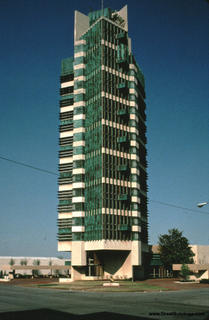
My mom and I came across Bartlesville after escaping a night of six tornadoes, late in the afternoon where half the sky was black (where we had come from) and the other half (where we were headed) the twilight clear calm over the immaculate, but desolate downtown of Bartlesville. The buildings and sidewalks seemed all less than 5 years old. Streets were named after presumably white business men. A miniature wallstreet? A town owned by Phillips Oil, designed by its planners. Again another deliberate idealization of progress. Mom and I stumbled across, and were surprised to find a Frank Lloyd Wright Museum. It was about to close but we looked for a short while, thinking that capital “A” Architecture doesn’t seem to fit here. Now, I question why it shouldn’t fit.


Now I believe how wonderful it is that it exists. How eerie and nostalgic and beautiful, how idealistic this town was, and determined to make itself seen.

And that’s why I love skyscrapers, and most other immense constructions. Not because they are necessarily useful or the realization of human potential, but because they are so loud in their exclamation to the world, yet imminently vulnerable and naïve. (Like big dead gravestones.)


Below, a great exhibit.
http://www.moma.org/exhibitions/2004/tallbuildings/index_f.html

Thursday, September 08, 2005

this is a test to see if it works.

A Letter to a Friend Upon Whose Return from Being Missing has hurt Everyone who Loved Him.

09/07/05

I am sure you saw walking through the fields,
boardering the interstate,
passing the blinking pylons and radio towers,
that they are not corroding in the monsoons
They are made with of a coating,
which protect us against that.
But imagine if they did.
And if the city smelled like wet coins.
We’d want to leave the city.
But we are here, its true.
All of us cloisted and protected and accounted for calling into work on Mondays, calling home when you work late, calling just to say hi.
So I hope,
You've recoverd what it is you were trying find, but

Amazing to think that with all this talking that no one is able to say anything.
This is a notion un-new to the world, of loud mutedness,
All humans yelling at once through pillows, screen doors, up stair cases, out car windows, to cell phones and drive-thru intercoms.
Asking for things and persons to come to them

I hear a report that you sat on the hood of your car one evening,
At a Drive-In, and spoke to no one,
And in the ensuing double feature you must have stared steadfastly past the screen
And into a pixel as large as your head
As immense as the entire west falling moon behind the mountains.
I've done this too on the occasion when I am trying to conjure some reason why we need people, walking down Congress St.
when all the fast-moving blurs of cars and
reflections of my passing self in the shop-front glass are rendered sightless through the tears that roll tumbling beneath my sunglasses in the bright lunch hour.

I have imagined since that what you were staring at was the great rear view just behind you eyes. If you could see it, you’d see the woman who was your friend, the friend before you lent her to the couch and to the meandering alleyways at 4 am with a clove in her hand. The woman who is so small under her covers when they are pulled tight over her head like her taught lip at parties when you lashed out at everyone, she is the woman I call my best friend now and she is the woman I let sleep without the covers because she needs no protection from me, unlike from you, who tears up, cowardly, and scabs over and tears up more and watches pixels as big has his head without saying a word to no one after returning from a monsoon with nothing to say!

Powers of Description

I saw this girl I knew at the mall. I caught up with her to ask her a few questions, Where have you been? We all thought you moved away, like WHERE HAVE YOU BEEN? With a side-step, she dodged a man carrying a sausage pizza on a paper plate. Our eyes followed it and re-met. I wedged in. She said hey to me as if we had spent the whole afternoon together, but had decided to split for a minute so she could go to the pet shop and I could go to the ATM. As if, plainly, “Hey. You’re back.” Her heels slumped to the side of her sandals, making the suck sound that sandals do when being dragged along.
“I’ve been home,” she said, stopping in front of a pretzel making display. “I’m just not ‘home’ home because I take a lot of walks.” She asked for a sample. The pretzel girl held out a glistening cube of icing dough impaled on a toothpick. “Thanks, Becca,” she said to her. We turned away. “You know her?” I asked. “Yeah, I met her the last time I was here,” she said before halving the morsel with her front teeth, exposing her gums as a means of not getting the gooeyness on her lips. “When was that,” I asked.
“Monday.”

We walked side-by-side for a while not really saying anything more than a “Do you wanna go in here?” followed by a “nah.” I looked at her when we stood in front of vendor carts and store windows and made innocuous comments about the posture of mannequins, or tranquil desktop fountains, or whether movie posters appealed to us or not. She was still clear-complected, I thought; skin like peaches-and-cream, though that description does not suit her expressions; which, if she had any, could just barely escape the ropey face-shield of ashy brown hair that came between us. “You know,” she said picking up a mall map from an informational kiosk, “I haven’t been to movie in whole month.” She opened the map, “Have you ever been to the theater here?” She never looked up when asking questions. “Lots,” I said. Her finger found it on the map. “It’s next to Sears,” she said. “What do you want to see?” I asked.
“I think that one we were looking at looks pretty good.”
“Which one, the Mr. Ed remake or ‘A Stone’s Pitch’?”

“A Stone’s Pitch,” she looked up at me. She still had brown pearls for eyes.
And then I thought of the fairy tell, “Lend me a looking-glass; If that her breath will mist or stain the stone, Why, then she lives.”

**

We sat down in the right-most wing of the empty theater. She had bought a small vanilla frozen yogurt and a small bag of buttery popcorn, which they had arranged conveniently for her in a cardboard trey that she now had on her lap. The theater was oddly without muzak and was bereft of any Wednesday afternoon movie-goers. It smelled like hot dog buns and musk, and it was very cold.
“I love this place,” I said, Hardly, anyone is ever here.” She sprinkled a few popcorns on her yogurt and then spooned it into her mouth. Malls as far as American institutions go are nearing there mid-life crisis, soon they will be as nostalgic and charming as town-squares. Former air-conditioned, concrete containers of entertainments and diverse consumer activities, but limiting no-less. Now, the entire city is a mall. Besides, there was a 20-theater mega-plex across the street. It guarantees stadium seating with reclinable plush chairs, ample knee-room and spacious cup-holders. Even during weekday matinees, sometimes, the lines were so long that they curled around the sides of the theater. And within a breaths moment of opening the doors all the people dispersed inside the cavernous gallery of concessions and reorganized themselves into smaller lines. I don’t think they sold yogurt there.
“So you like a popcorn-yogurt blend?” She was slow with her treat, crafting each spoonful with a proportional amount of crunchy to smooth, dry to wet, sweet to salty.
“When the two can be bought at the same place.” She said.
“You know I remember when we were little our parents made us front the tables at the neighborhood association’s bake sale.”
“Yeah I remember that.”
“Remember those cookie bars with little green and red jelly cubes in them.”
“Those were gross,” she said recovering from a swallow.
“Yeah,” I looked at her bare knees. “Some combos just shouldn’t exist.”

The lights went down. Then there was a rather hilarious commercial about how to exit the theater in case of an emergency, with an appended moral lesson in courtesy. It involved loud, disruptive teenagers and an elaborate scheme on behalf of everyone else in the theater to trick them into exiting through the exit doors, but then the entire audience-standing outside the theater mischievously crept back inside leaving the two alone and confused and unable to reenter. She smirked.

So there we were, watching a movie together. I saw her last hunched over in the passenger seat of my car, hugging herself. I hadn’t let her in. In fact, she didn’t even know it was my car. That was months ago.

Favorite Ever Creation

Meezers


sofia coppola-like

A new distraction


So here is my blog. No one knows it exists. And I have yet to discover its magnificent e-features. But here is some writing:
Girl at Desk Half way around the world.

To the kind people that live approximately half-way around the world, presumably in the western high deserts of China, Kyrgyzstan, or perhaps Southeast Asia, Yellow Sea vicinity. I am not sure.
This is a message from a girl working at a desk in an office. I live and work in a medium to large city in the United States. It is a city full of abundant grocery stores and housing opportunities, though not as much as we would like. By most standards, there is an orderly traffic system and almost everyone could have a job if they wanted.
Anyways, the desk I sit at is in a small white house, which serves as my working place. At my desk I have a very well equipped computer that plays whatever music I like. I have a phone and can call whomever I wish. At my job I have many freedoms, but I also have a fair amount of responsibilities. In my office, I have access to a constant supply of fresh, cool water that is released from a large jug atop a dispensing spigot. There is also a refrigerator with ice and I am allowed to store my own food for snacks throughout the day. I can have snacks whenever I want. Often throughout the day my co-workers and I take breaks to walk to coffee shops to buy delicious pastries, ice cream, and sweet beverages. We take the time to discuss each others personal lives, within the reasonable limits of disclosure to maintain productive professional relationships. At the end of the working day, approximately eight hours or less, I ride my bike home. And eat dinner.

Wednesday, September 12, 2001

Tuesday, November 20, 1990

Pushing the Right Buttons:

A tale of Vending Machines and their Social Products
By Hannah Pierce-Carlson


Introduction: Thirsty, Hungry, and Conveniently Satisfied

There it is in the dimly lit employee lounge after hours. No sound but the squeaks on the linoleum and the whirring business that allures you to it; and there is the glow emanating from the machine whose promise to refresh is emblazed across its Plexiglas belly, a tearing can of Coke product thrust sideways into a exploding mountain of ice. You insert and press, there is a moment, a thud, and you receive. How many times have we transacted in this way, countless times? This is not a monetary-product transaction, not just. Perhaps this is a cultural experience. Perhaps, being so esoteric to suggest, this transaction is a metaphorical gesture for the taken-for-granted availability and accessibility of everything we consume. There is the compulsion to transact with the vending machine, after all its so convenient, and to receive from its mysterious delivery mechanisms its generous, yet necessarily limited, bounty of delicious, practical, and sometimes uncanny products. The transaction with the vending machine is a fetishistic experience for the consumer, gratifying in its self-serve autonomy, anonymous and removed from human interaction, and instantaneously rewarding. In this brief history, I discuss the development of vending machines and their cultural and social impacts.


A Brief Vending History
The development of vending machines and their array of vending products is a story messy with a multiplicity of different innovations, too many to discuss in this paper. However, it is curious that with all of these early vending machine innovations the technology could have taken many different directions in its evolution, yet alas we know them popularly as dispensers of soda and snacks only.

The vending machine era is dated around the 1880s, but the earliest reference to coin-operated devices goes back to the Greek mathematician Heron in 62 A.D. In his book, Pneumatika, he describes a vending device for sacrificial water in the Egyptian temples. There is no evidence that the device became widely used. It was not until the seventh century that the notion of vending machines was revisited. Snuff and tobacco vendors appeared in English taverns and inns during 1615. The machines were primarily innovated by the British and Western Europeans. 1857 marks the first automatic selling device patent in Britain. The technology was imported to the Colonies and U.S. patent for W.H. Fruen’s “Automatic Drawing Device” was issued in 1884. The technology was not dissimilar from Heron’s holy water dispensing machine though it was never produced in quantity. Much of the early innovation was driven by the goal to combat misuse, slugs, and users trying to “beat” the machine. One of the original patented inventors Percival Everitt observed in his patent application that:

“It has been found in practice that although the apparatus is perfectly successful when not designedly misused, articles such as paper, orange-peel, an other rubbish have been maliciously placed in the slit provided for the admission of the coin, and that in consequence the channel provided for the passage of the coins from the slit became blocked” (Schreiber 13).

The real story of American vending began in 1888 when the Thomas Adams Gum Company introduced the very first vending machines to the United States. The machines were installed on the elevated subway platforms in New York City and sold Tutti-Fruiti gum. In the early 1920's, the first automatic vending machines started dispensing sodas into cups. In 1926, an American inventor named William Rowe invented a cigarette-vending machine. The Rowe Corporation became the largest manufacture of cigarette vendors and cigarettes became the premier vending item (Schreiber 19).

Despite the economic hardship of the Depression, the 1930s was a very lucrative time for the coin-operated machine industry (43). Many of the developments of the thirties had to await the conclusion of WWII. The introduction of VMs into the industrial plants created a new market niche for the products. In 1942, the War Production Board suspended the manufacture of new vending machines and production was turned to materials for the armed forces. During this vending production hiatus the operating companies struggled to keep going. As the war effort deepened the challenge to operating companies intensified until industrial plant mangers, who were at first skeptical of VMs distracting workers, discovered that the vending machine was an invaluable tool for keeping workers on the job longer. A quick candy bar or soft drink kept workers “refreshed.” The demand for vending services was more than the industry could satisfy. This boom persisted though out the war and after it (Schreiber 44). In the work place the VM was being used for a real social effect, to keep the workforce satisfied enough to extract that much more labor out of them.

Not all coin-op devices were embraced precisely because of their suspected of feared social effects. Amusement devices such as slot (gambling) machines and pinball games enjoyed a boom more so than any other amusement machines. However, community protests against the gambling machines in some places led to area bans. As we will see coin-ops and vending machines will have repeated encounters with community protest. The vending industry like most convenience technologies of the ‘era of innovation’ has an interesting history of ambitious profiteering, and often at the expense of the well being of its consumers.

The industry dreamed big and experimented its way into various market niches, the technology itself, especially the goods being sold, have hardly changed over the past decades. Instead, the industry in its stagnant technological development experienced growth by becoming culturally pervasive, more so than being innovative. In the early days, vending technology was touted by the industry to bring a revolution in the retailing and distribution of products, not to mention their immense advertising value (Seagrave 44). At a 1947 annual National Automatic Merchandising Association (NAMA) convention, Nathan Cummings, president of the wholesale and retail firm Consolidated Grocers Corporation said, “It is possible to foresee completely automatic grocery supermarkets and automatically operated service stations” (Seagrave 122). Indeed, the technology could have afforded vast possibilities in the dispersion of food and other products not just relegated to soda, snacks, and cigarettes. However, these were the innovations to be capitalized upon because they proved most profitable.

The appeal of VMs to product vendors is in their labor cost cutting, real estate saving, invisible-seller attraction. I happened across a car wash retail Internet site called “Windtrax” that sums up the benefits of the vending machine quite accurately, “The vending machine is never late for work and won't ask for holidays off” (www.windtrax.com). Conventional retailers at first opposed the technology for its obvious elimination of human labor. However, Cummings argued that VMs would prove to help human sales people rather than replace them. Today, it seems virtually incalculable the effect vending machines have had on employment in any industry remotely related to the services provided so cheaply by automatic-seller machines. Imagine if each VM anywhere were a store employed by humans. That would amount to a lot of jobs. Granted, it would also equate to a lot (too much) of retail real estate.

Vending technology remained steadfastly “primitive” for much of its early popularization after WWII. The so-called “four C’s” (cigarettes, coffee, cola, and candy) dominated the vending niche market in the 1950s (Seagrave 47). Cigarettes remained the dominant item in the vending industry during this period. In the 1960s to 1985 the vending industry capitalized on particular locations. Plants and offices, with their captive employees grew more and more important as VM sites. Many companies began to eschew the usual live-service cafeteria and restaurants for the substantially cheaper VMs to provide food for their employees. A 1970 account reported that VM operators had to pay a 10 percent commission to the plant or office utilizing the machines (Seagrave 182). Therefore the industry turned its attention to one its most lucrative locations, schools.

The presence of VMs in school cafeterias has become an increasingly controversial issue since their introduction in the 1960s:

“The vending industry was making some strides in 1964 in the $200-billion-a-year school-lunch area, where banks of VMs had replaced hot meals in many high schools and colleges. That year, 107 Southern California schools converted from cafeterias to vending machine” (Seagrave 182).

The US government, state governments, most boards of education, and organized food service employees resisted the introduction of VMs. The National School Lunch Act, which offered cash and foodstuff subsidies to schools in return for a non-profit hot lunch program for children, was offered as the legal underpinning to keep VMs out. The industry led by the leading VM manufacturer, Vendo, used low-key persuasion to ease their way into schools while still keeping the federal subsidy. The machines entered the school but only on the stipulation that snack and drink machines be hidden in teacher’s lounges. In 1970, the USDA agreed to amend the national School Lunch Program to allow vending and food service companies to participate. Three years later, school lunch officials decried VMs that dispensed junk food, which, they claimed, threatened to undermine the school lunch program:

“Regulations that would ‘result in the exploitation of children’s nutritional needs by people whose interest is profits’ were then being drawn up by the Department of Agriculture to permit normal use of the machines” (Seagrave 183).

Shortly after the regulations passed it was noted in one Santa Fe junior high school that participation in the lunch program dropped from 350 to 235 and the breakfast program had been cut from 80 to 40 after the installation of the machines (184). Today, a battle continues in many communities across the country to ban VMs delivering unhealthy junk foods and sodas to children in schools (CNNAccess). This battle is not unlike the fight to ban cigarette vendors from the reach of minors.

In 1990, US Health Secretary Louis Sullivan urged the state governments to enact new laws discouraging the sale of cigarettes to minors. One of his suggested provisions was to ban cigarette VMs, the star product of the industry. Municipalities soon affirmed the right bans the machines. The industry fearful of losing its profitable cigarette stronghold developed remote-control devices, but they were dismissed as to cumbersome to implement (Seagrave 184). In 1995, President Bill Clinton announced his initiative to combat the ‘epidemic’ of smoking teens, which included a proposal to ban all cigarette vendors. The industry reacted with predictable outrage. They first argued that such a ban would have little impact on reducing teen smoking. Secondly, the cigarette ban posed to eliminate the industry:

“Representing cigarette VM operators in New Jersey, attorney Keith Biebelberg declared ‘You would be closing down an entire industry, causing massive unemployment. Many of these companies can’t stay afloat without the cigarettes vending aspect of their business’ “ (Seagrave 195).

Clinton backed down from a complete ban on cigarette VMs, though in 1997 he did approve US FDA rules that outlawed VMs in youth prone areas, such as grocery stores, restaurants, but still allowed them in bars, casinos, and establishments that barred underage patronage. Once cigarette machines faded in profitability, cola VMs grew. Near the end of the 1960s 12-ounce cans became the standard size for the vending industry. Over a period of 20 years can VMs replaced returnable bottle vendors and grew to represent 95% of the soda pop vending market (Seagrave 197). With the advent of the 16- and 20-ounce PET bottles soda vending became slightly more profitable for two reasons. The lighter weight, more durable plastic was easier to transport; plus, there was a sharp increase in the price of aluminum. In 1996, Coca-Cola beefed up its vending program by redesigning the machines and individualizing advertising graphics, trying to give the VMs a marketing edge:

“VM manufacturer Royal Vendors was making Troy Aikman- and Emmet Smith- (star players for the Dallas Cowboys professional football team) identified machines for Coca-Cola for use in the Dallas area. According to Ray Kohlepp, vice president of Royal, the Aikman machines had been outselling regular machines by a ratio of three to one. The company also made machines for Universal Studios that features Bugs Bunny graphics” (Seagrave 198).

Clearly, the VMs are living up to their promise as advertising beacons. This is what is so dangerously alluring to children who are held captive in schools that are becoming more and more corporatized and saturated by brand name junk foods. The soda vendors, most notably Coca-Cola is in the business of exclusive contracts in schools:

“In a move that gave it access to more than 300,000 students, Coca-Cola Bottling outbid Pepsi to win an exclusive three-year deal with the Toronto District School Board to sell soft drinks and juice in its schools…Some 200 Pepsi machines had to be removed…Critics opposed corporate control to that extent as well as the replacement of government funding with corporate money. They were also opposed to the spread of sugar- and caffeine-laden products with limited nutritional value to school children” (Seagrave 217-218).

Children are being bombarded with appeals to consume everywhere they look. Now the technology is becoming even more insidious, pervasive, and perhaps intrusive.
Currently, VMs are undergoing a “smart” makeover, promising “wireless” vending. One Coca-Cola technology involved various cashless systems, including the use of a cell phone to order a soft drink:

“A customer used his cell phone to dial a number on the VM, punched in a code to purchase a Coke, with the charge appearing on the customer’s next phone bill” (Schreiber 232).
This intelligent vending is slated for “the future” and is only to affect a limited number of machines, but one must ask what is the benefit of hooking-up with the soda machine? Clearly, this is a novelty device for the sake of drawing in more consumers. However, Coca-Cola has innovated a very different ‘smart’ machine that may accomplish the opposite effect.

In 2000, Coca-Cola tested a controversial vending machine that would raise prices on a hot, humid day and lower them when temperatures fell. With such innovations as adjusting prices based on demand at a specific time, such machines appear to only be the first of many innovations by the nation's soft-drink manufacturers in an effort to exploit the highly profitable vending machine market. The vending industry today is taking the ‘wired’ approach to dispensing technology. One article on new vending technology reports excitedly that:
At the US vending industry's annual convention last month, the buzzword was interactivity: machines that can chat with mobiles, email the home office when they run out of Doritos, flash the latest CNN headlines. All of it is happening now, albeit on a limited basis” (Stevens 2002).
Surely, if the VM is to become a new ‘connected’ form of media in which one can receive their news as they fatten their phone bill and gut, then it is shockingly clear that this technology is not just a machine, but a significant cultural object. The vending machine is as ubiquitous as the billboard and television and it products are just as alluring. Our interactions with it are as distracting and impulsive as any other consumer landmarks that blight the cultural landscape.

The Right Buttons, Wrong Products?
Consider how pervasive vending machines are in the public environment. If one is not in plain view I sometimes feel I can sense their presence, just around the corner maybe? Lo and behold, there usually is one. They are “convenient” stores that fit anywhere and, apparently, belong everywhere. My high school had a whole slew of them in the cafeteria lined up along a long wall. During lunch the lines to get soda and junk food were usually longer than the hot-lunch lines. It should be no surprise to most that there was a substantial decline in participation in the national School Lunch Program with the installation of VMs in school cafeterias in the 1970s. Now kids get their “meals” from the “silent salesman” as it was first referred to in the earliest vending advertisements (Schreiber 9). What good silent salesmen they are. “Last year Americans bought more than 21 billion cans of soft drink from vending machines, 10 billion candy bars and 4 billion hot drinks. All told, it came to nearly $US41 billion ($72 billion) worth of products. (In 1960, the figure was $US2.5 billion. In 1990, it was $US22 billion.)” (Stevens 2002). A bag of Doritos, Skittles, and a Mountain Dew, might be a typical lunch for an American kid these days. How obvious it should be that we are a nation of fat kids. Surely these machines have changed not only what we eat, but also the way we eat, how we think about eating, the accessibility of food and other consumer goods, and the pervasiveness of so-called choices. We have seen that because of their advertising value vending machines are alluring to children, especially when they are held captive in the classroom. The four Cs have proven to be the most profitable for the vending industry, but this is not because vending machines were destined to deliver nothing but junk food and sodas. On the contrary, the technology could have gone in many directions, yet the same products persist because very large product companies would rather make a convenient profit than think of the small, though rather significant, impacts that vending machines have had on our culture. Their hyper-pervasiveness speaks to our over-the-top expectation to be conveniently serviced wherever we go. The vending machine beckons to the consumer, and asks him/her to be impulsive because, heck, why not it is so easy to give in, to insert and receive.


Bibliography


Image from "http://www.cwrl.utexas.edu/~williams/rhe306_04/table_o_guys/vending1.jpg"

“Nutrition Advocate: Vending Machines fail students.” CNNAccess. 15 Sept 2003

“Vending Machines Grow Up: Candy Bars and Soda Make Way for Movies, Live Bait and Even Prescription Drugs.” Washington Post. 27 July 2003

Schreiber, G.R. A Concise History of Vending in the U.S.A. Chicago: Vend, 1961.

Stevens, Liz. “In the Slot.” New York Times. 15 Nov. 2002
http://www.theage.com.au/articles/2002/11/15/1037080910605.html

Seagrave, Kerry. Vending Machines: An American Social History.
London: McFarland & Company, 2002.

Saltman, Kenneth J. Collateral Damage: Corporatizing Public Schools-A Threat to Democracy. Lanham: Rowman &Littlefield Publishers, 2000.
Sunday, November 11, 1990

School for Correction of Ways in the Plains

Matt made it for me for but a mere moonpie plus a hug! Thanks!

Thursday, November 01, 1990

catch!

 Posted by Picasa

My name is Hannah Pierce-Carlson