A friend and I spent a late evening last Tuesday stumbling through the cinematic and bizarre alleys of Beijing's little Moscow, a neighborhood from what I can gather, whose primary industry is box packing, foot massage, and liquor stores. But no matter what the stores sold the innumberable signs graced us with the unusual coupling of female models in either furs or camisoles with adjecent images of fierce animals. 
 The night was accompanied with the sound of 100 men rolling packing tape. The alleys turned factory floor, were full of such men in heavy floor length soviet army coats. Every little alley was strewn with hundreds of large boxes of which the sombre men, most of whom were simultaneously smoking, were taping every square inch. A man in a bicycle rickshaw encircled us yelling, "bee cluh cluh." The night only got more gloriusly confusing....
Wednesday, March 29, 2006
Little Moscow
Tuesday, March 28, 2006
Deja Vu
An unshakable feeling of certainty consumes me. There is now a single track of dialogue in my head, this has happened before, this has happened before, this has happened before, I am having déjà vu, I am having déjà vu. It occurs to me: maybe in Spring, Tx? In Huntsville, Tx, a back road in France, in Chandler, Az? But I can’t place it anywhere else; only in this spot in China does it seem right. And then it passes.
This is the second time since I have been in China that I have had a powerful spell of déjà vu. The first time was a few weeks ago at the Bookworm, a café where I had gone to listen to my boss, David, read his essay about the schizophrenia of modern Irish literature. To say nothing more, it was a unique night. But the sense struck me as I was sitting across from him after the lecture. He was smoking and we were both amidst a conversation at the table. I was just listening to someone talk when it struck. And then this has happened before, this has happened before, this has happened before, I am having déjà vu, I am having déjà vu .I am not trying to be poetic I just want to describe this. The feeling is: my vision becomes soft and out of focus, secondary to the loud track in my head. Nearly like nausea. It’s like an absolute presence in the moment, full awareness of being somewhere, but at the same time the details become background noise.
The chalk, the cold, the wind. My nose is dripping. There is an urgency to blow my nose. I have only my wool gloves to wipe away the drips, but they are steely and abrasive. My wet nostrils burn and crack in the wind. I am running quickly but it’s effortless. I approach the end of the wall. The road turns right into the space contained by the wall. A convoy of red trucks pass. The plume of chalk subsides and I see momentarily in the bobbing headlights of the trucks ahead of me a vast expanse of rubble.
My earliest moment of déjà vu (that I can remember) occurred when I was about 6. I had gone to visit my grandparents in Columbia, Tennessee. That year they lived in a very old stone mansion. There were a few rooms that were furnished, but were rarely used. The large dining room was one of them. One afternoon, I was walked from the main foyer into the dining room. (Perhaps this is the most vivid memory from my childhood). I remember being overwhelmed passing through the threshold of the door. I noticed that the wooden inlays in the flooring change direction from room to room. Something inside of me said, “You’ve been here before.” Then I pulled out a chair and sat down at the long dining table. I remember feeling very empty, as if I had no reason to ever leave the table. Until eventually it passed.
The sight of the field of rubble scares me. The chalk is thick in the air. Now that there is no wall I am exposed to the violent wind. I turn and run home.
Sunday, March 26, 2006
Speaking English
Assignment: Fill in the blank.
I like to eat grapes because they are so so so so very very very small.
I want to rob a bank, but it's only a dream.
I want to climb a tree, but I do not live there.
Shall I....for you?
Assignment: Lily is a dolphin and she wants to go to the movies.
Lily, shall I buy a VCD for you? {VCD, meaning a pirated DVD}
Lily, shall I put VCD in a glass room for you?
Lily, shall I put glass room in the ocean for you?
At the Olympics...
Assignment: Fill in the blank
At the Olympics, I want to be an environment bodyguard.
If it rains I will have the largest coat. The sports heros will go inside it.
"Nei ge" literally means "that," but I suspect that it is the Chinese equivalent of "umm.." Despite a limited vocabulary, some of my 8-10 year old students desperately seek to express themselves outside of giving the most obvisouly correct answer. I know that something clever is coming when a student repeats the phrase "nei ge, nei ge, nei ge" stomps their feet and beckons over the chinese speaking co-teacher to ask for that one special word in english that they only know in Chinese. But most of the time they cull from that limited range of words they do know and arrange something that can be more expressive than knowing every word in the world. I think that is one of my favorite delights in speaking or speaking with a person that does not have fluency: the "misuse" of a phrase or word can lend an otherwise unconsidered statement a less direct, more nuanced meaning.
A tiny example: When Haiyan calls me to dinner from my room instead of calling out "It's ready" she asks "Is it okay?!" To me, though surely it's not intentional, it seems to express both her request to come eat and simultanesouly her modesty in presenting the food that she has cooked for me.
It has also struck me that the translation of even the most basic phrases can reveal subtle differences in cultural perceptions. Another tiniest of examples: I have been sick with a cough lately. Many of the chinese teachers, as well has Haiyan, have suggested that I "eat some medicine." When I ask them what kind of medicine, I am surprised to learn they do not mean traditional Chinese types of medicine, but rather western medicines of which I would be familiar. It is the subtlety carried in the verb "eat" that leads me to such a conclusion. Typically, in standard English, we "take medicine." Medicine is thought of as chemical, artificially created, something unlike food, even though we put it in our mouth and swallow it. Chinese medicines, however, are, if not whole foods themselves, such as funguses, roots, etc, or essences of foods, no different than everyday foods that one would eat at a meal. They are just consumed in different arrangements when one is sick. So, it would be reasonable to assume that one would "eat medicine". It makes more sense to me, than the phrase "take your medicine." Take it where?
Friday, March 24, 2006
Amusement
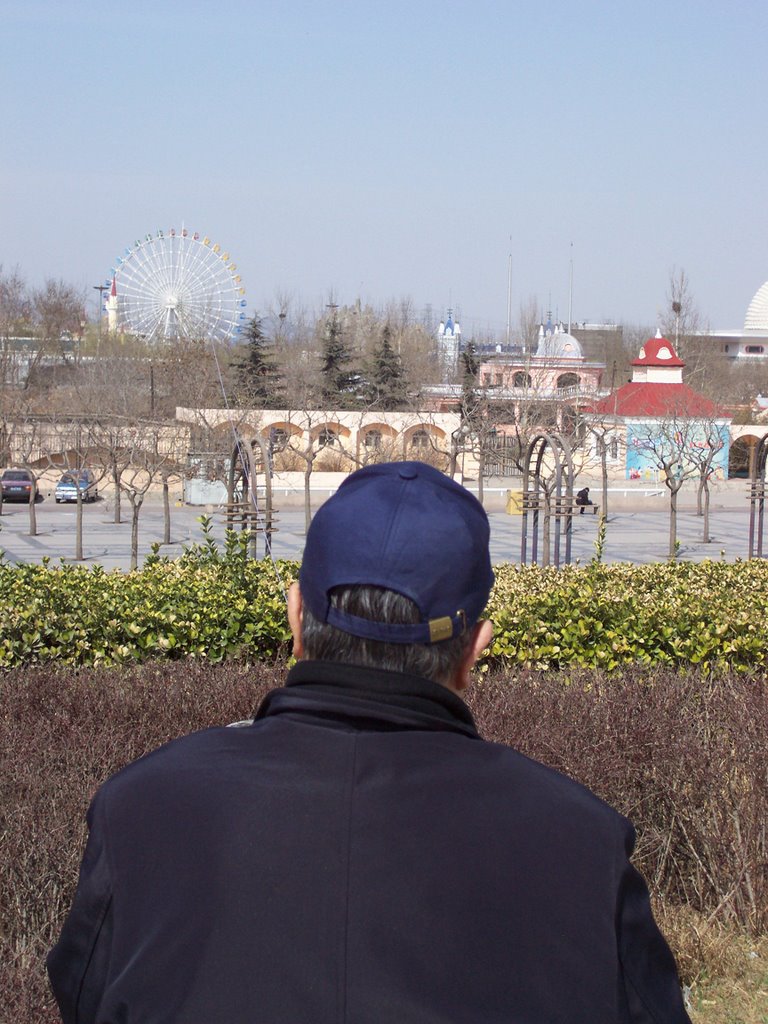
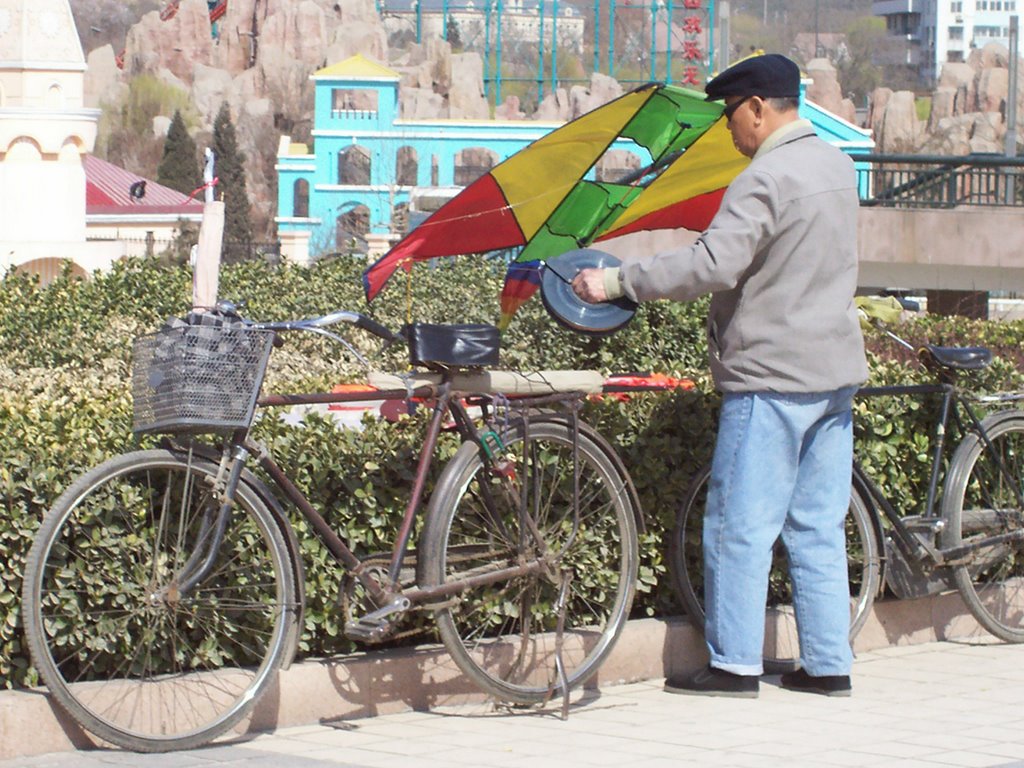
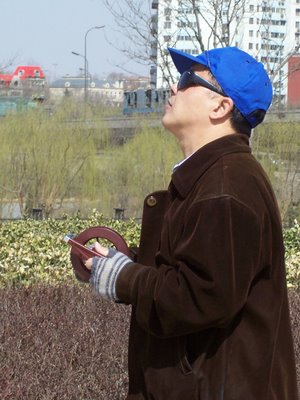
(This man was impressively flying a kite while sitting on a park bench. The kite was so high I could barely see it)
I could go a little out of my way and walk along the main boulevard to school. This way I pass Shi Jing Shan Amusement Park. I can see the park from my room on the 14th floor, and although it's supposed to be closed during the early spring, every now and then I can see the ferris wheel turn, or the rocking ship ride rock, or one of the smaller roller coasters move up and down. I suspect that they are merely testing the rides. But we are edging day by day to a beautiful warm, windy spring and as I pass the park the old men are out in full gear to fly kites.

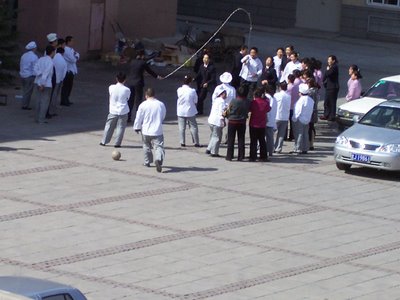
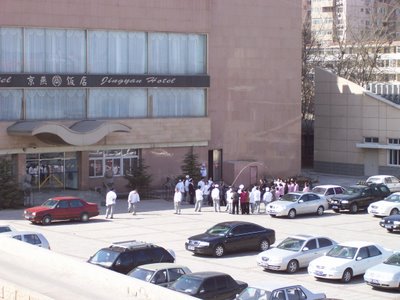 Jing Yan Hotel staff gathered in the parking lot for group rope skipping.
Wednesday, March 22, 2006
Glare
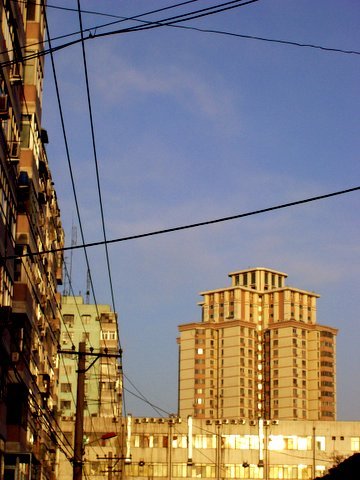
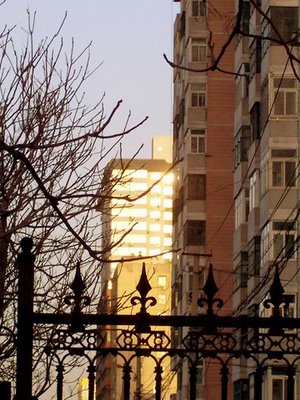 It struck me leaving the school today around 5:30pm, that after writing that last post before class I should then immediately seize upon my idea of taking photos based upon a miniscule theme, lest it begins to sound stupid. So having only a fleeting 30 minutes before the sun had completely sank behind the buildings and past the buildings sinking further beyond the Fragrant Mountains to the west, I chose "glare."
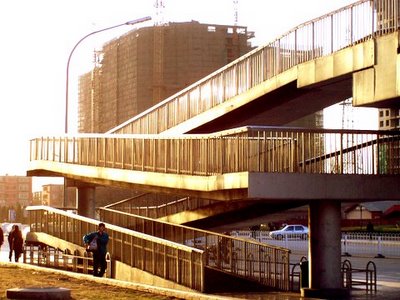 And as I struggled to find anything that glared with the setting sun I confronted my first technical obstacle: I approached the object soon the glare would vanish.
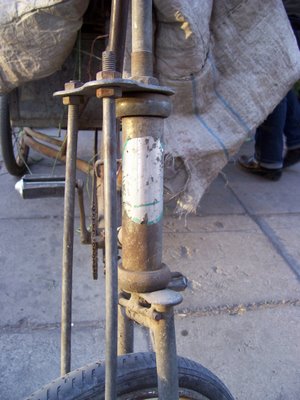 A fool chasing papers in the wind. Of course glare, like a mirrage, is a function of ones vantage point and there's a moment where you cross a delicate line between it existing and not.
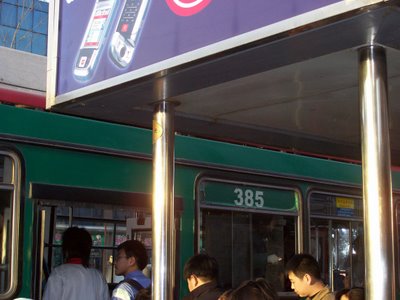 In the course of finding any "piece of" (?) glare and then holding my camera up to it, some of which were rather uninteresting structures, I became the subject of some stares and laughs. Though this isn't unusual.
 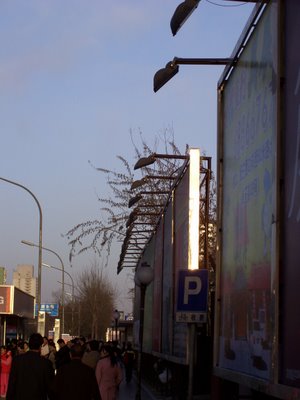 The sun nearly sunk, still walking home, and still determined to locate glare, I began to see small glints of the sun in far off, un-photographicable distances: off the back windows of busses, here and there off the windows of large buildings, off the helmets of passing motorcyclists. The smallest, tinest glare soon popped out at me amid the rather dull grey city boulevard at dusk. The first seemingly obvious conclusion of my experiment: if one does not look for it, one does not see it.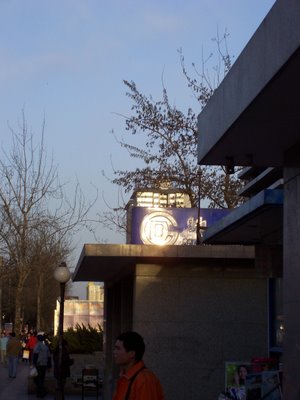
This is essentially a beginners photography assignment, but no matter. As I was taking the photographs the process was not about the picture, but about the hunt. And as it turns out, now that I look at these photographs, they are of structures I pass everyday, objects never begging to be photographed. 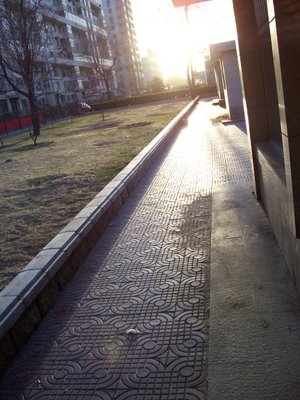 There is no great way to capture the smallest thrill admist the rather mundane sights along my route to school, but still, they exist. People walk down the street and we look at the world. We don't neccessarily judge it, "this is a boring walk." Something, anything must capture our attention else we'd make ourselves miserable all the way home: a frayed wire on the ground, the way the person in front of you walks, the people behind the glass in the restaurant, a piece of garbages' 1 minute of fame. Its like how collecting pennies makes pennies special. So here is a collection of pictures of glare. What does it say? But then again, if we labored over every insignificant object that had held our attention for the merest of moment, we'd be more pathological than we already are. Or maybe we'd be a slower, gentler animal. who can know?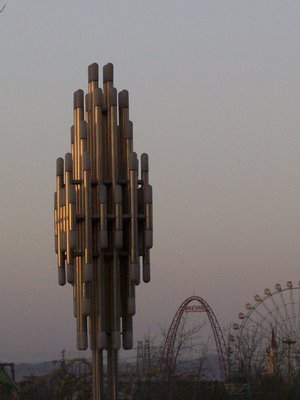
Density
I am always aware of myself here. One cannot be unaware when you constantly stared at and not uncommon to be followed. Or when you so blazonly walk down a street that by appearances alone could exist 100 years ago with headphones and silver camera. So it is my present condition to be aware that my outsider status lends me a perception that is mostly innocent and everything is cast in the hues of this naiveity. It is romance, whether beautiful, or exotic, or textured and real. Certainly, unoriginal. I thought maybe I could quell my impulses toward the random by being more conscious of the place. Charcteristic of the oustider is his/her tendency to take everything in one exagerated gulp. Hence the quentessential shot of the subject in front a landscape, that serves mostly as a backdrop.
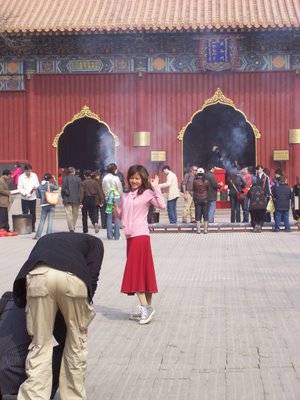
I think of a collage painting I made (the only one I ever liked) of tourists at Yosemite Park. Everyone (backs facing us) is lined against a stone wall positioned in front of the most stunning vista of El Capitan and the canyon falls, the view found on every postcard and poster. Everyone takes the same photograph. Everyone at least while standing there sees the same thing, an inspiring collection of geologic forms serenely existing in the seemingly quiet wilderness. However, while stepping outside the photo is very different place, a place full of people chatting and laughing, cars passing by, etc. And though the experience of taking the picture with everyone else is unifying in a way, where we could all share the moment of wow here it is look at that, I suspect that most of the time when we are tourists with that sweeping gaze we are complelled to take certain photos over others because we seek what we have seen before. Somewhere buried in that statement I think is the defition of beauty. Recognizing the familiar or the obviously unfamiliar, practicing seeing what we've been taught to see.
So, if I could come up with a very specific subject for the day and practice looking for that subject, even perhaps if it is painful to look for, then I could, maybe shake the habit of looking for the "shot." Then perhaps I could experience a place from a slightly altered perspective than that from a tourist who takes in everything all at once. Afterall, if I am to take pictures of my life and if I should write about my experience than I should accept that I will live in mediated way. And if it should be mediated, be it by camera or writing, then it should be refined. I am not trying to be more artistic, I just want to find a more engaging way to be a tourist with a camera
After having those thoughts I found a photographer who is doing something I really like. His name is Michael Wolf here is the link. It is fashionable to take photo projects of singular subjects. There is something pleasing about the collection of similarity in the landscape. When we put something in a collection its an mostly unnatural state. The easiest aesthetic to produce is a collection, maybe quickest path to art.
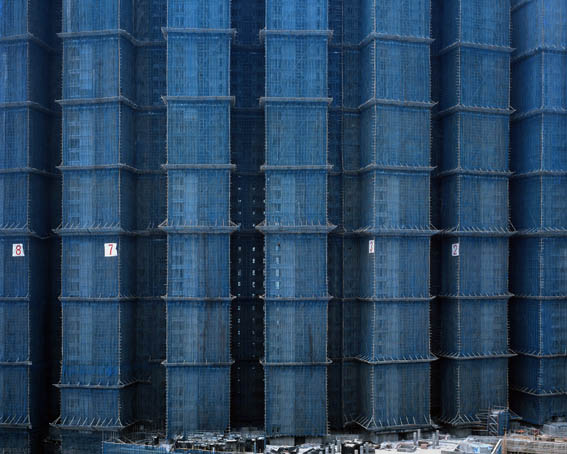
Here are some astounding photos of high-density living in Hong Kong taken by Micheal Wolf. http://photomichaelwolf.com/hongkongarchitecture/ his other photos are cleverly uniform as well.
While I am at it I will mention a really nice blog called "Random Stuff that Matters," http://www.houshuang.org/blog/which is actually more smart than the title might lead you to believe. I hope to fashion my own site with same smartness.
P.S. I've wanted to say this...I don't have a lot of time to edit my writing, plus I cannot see this webpage as my site is blocked by the Chinese firewall. So, don't hold by misspelling, missing words and grammer against me. One day I will edit.)
Monday, March 20, 2006
Bad Pictures related only by the fact that by taking them people stared at me with blank expressions even longer than usual.
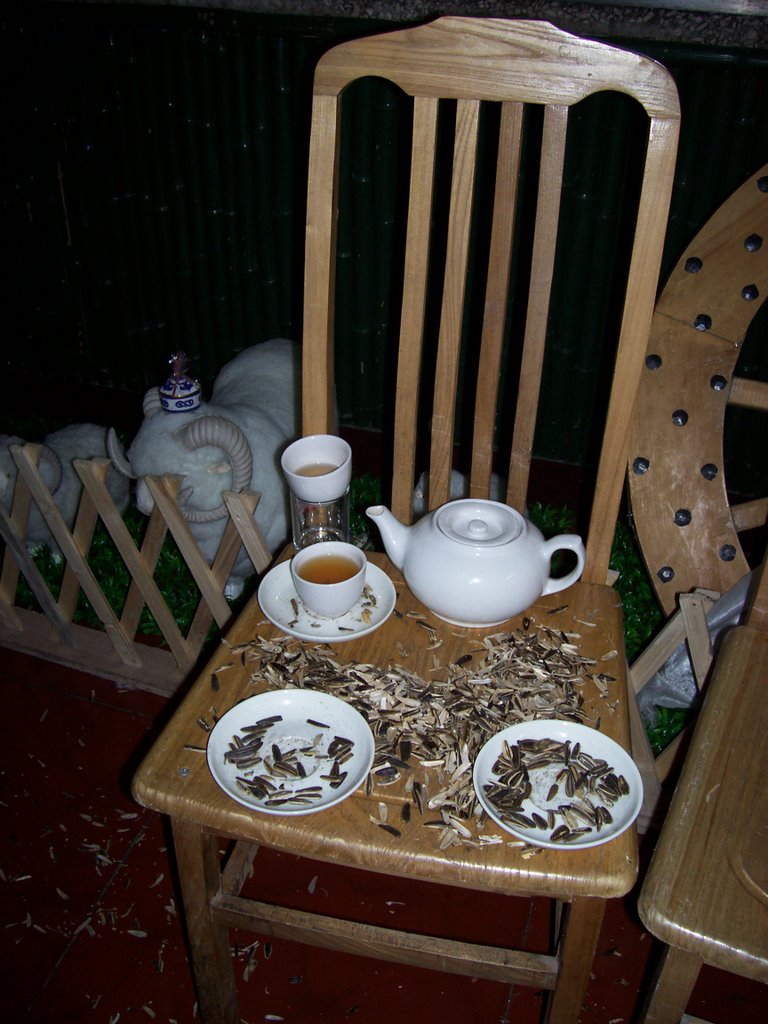 What happens when the Chinese must wait to be seated. The sunflower shells were all over everywhere, like sawdust in a honky tonk.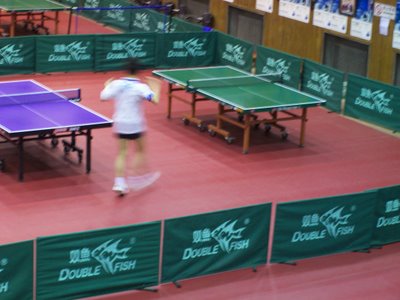
Ping Ponger warming up.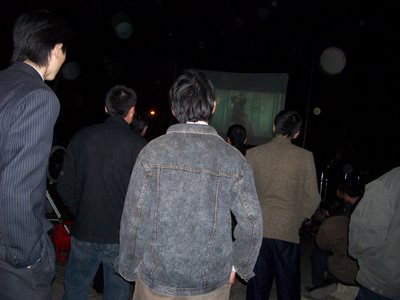
The People's Cinema. In my school's neighborhood they hold free sidewalk screenings of brand new pirated movies. Just like in the good old days when the towns people gather to watch propaganda films, and films limited to those from other communist countries such as, North Korea, East Germany, Soviet Union, and Albania.
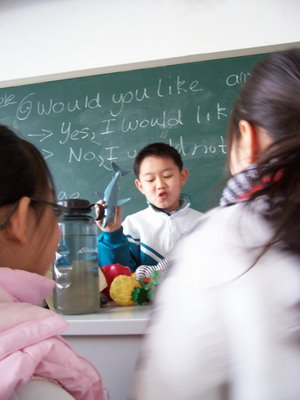
School time.



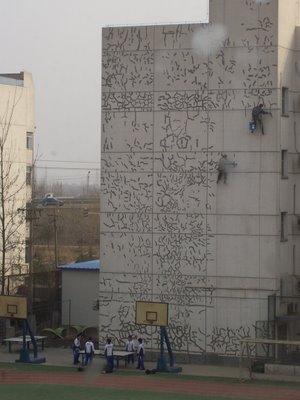 They were painting those swiggles, not painting over them.
Wednesday, March 15, 2006
A "Bao Xian" of My Own
Wed and Fridays I teach in a public school, Gu 6. It's old enough and poor enough to still have the three portraits of Mao, Lenin and Marx in the entryway. It smells like pee, its cold, they often don't turn on the lights unless I ask them, but the children are very sweet and seem to love my lessons. I never have to yell or pound my hands on the desk to get them to be quiet. Gu 6 is markedly different than Jing Yuan, the rich private school, where many of the students are leaders' children. They are given nice school jumpsuits and some believe they do not need to study English because they could just hire a translator. Its ranked the best school in all of Shi Jing Shan District of Beijing, but from my experience so far and what have heard from past teachers is that the classes are rowdy and most have the reputation of being brats, which defies the stereotype of a well-mannered Chinese student. Even some of my good students can be obnoxious about it. For instance, when I ask a question the "good students" often thrust their hands like ramrods in the air, jump up and down and whine "Teacher! Teacher! Let me try!" over and over again. Its rather disruptive. I tell them 'I will not call on you if you are obnoxious', but even still some persist in thinking the loudest wins.
There are no legendary portraits at Jing Yuan, but written above the entryway, in big silver lettering, is "I have a Dream." Its historical associations of civil equality and making the future brighter make it an appropriate school slogan. Plus, the civil rights movement can be seen as an extension of "class consciousness", thus there is a fondness for this moment in American history. But, and here is the post-modern cynic in me, the phrase has also been used to sell Nikes. In certain contexts it is a statement of individuality and personal desire. I believe both the former and latter meanings are at work. Or this is how I choose to see it.
From an American perspective, I think there is a tendency to see the communist revolution as a period of ideological brainwashing, the scale of which seems absurdly heavy-handed. Children learned Marx in school, and adolescents carried Mao's little red book, and studied Maoist Thought. These children who grew up after the tragic famines of the Great Leap Forward of the early forties, where re-taught the history of the Revolution, they forgot the failure and suffering. The Cultural Revolution that followed was to obliterate the legacy of suffering and invigorate the dream of a productive class led by Mao. The personality cult of Mao was born. I think we see this as something wholly alien. However, if we are to consider the history of the US and China in the 1950s in tandem the adherence to communist ideology in China was as strong as the adherence to capitalist ideology in the states. The threads of American and Chinese history seem to run diametrically opposed, but none-the-less occurred with just as much intensity. Granted, China's ideological shift was more tragic on a larger scale than the US at that moment in time. But, I think if we consider the subsequent decades in the US, the Vietnam war, American foreign policy, and the wars that continue to this day, we see that the reverberations to the ideological shift made in the 1950s, and the fervor for the American democratic (capitalistic) ideal, is just as destructive. These are bold statements, but consider that during the 1950s American society was becoming characteristically obsessed with the ideal of the American dream through capitalist consumption. This way of life now seems to underlie most geo-political decisions and it is the ideological principle behind our foreign policy, “repairing” states by opening them to (our) markets, so that capitalism can provide what the a failing government cannot. I could continue, but I think I have definetly strayed from my metaphor using the differences between the schools.
The socialist ideal is convalescing with a capitalist means of production. The line is so thin between ideologies and practice that rather than calling the government communist in name only it is cleverly referred to as “Socialism with Chinese Characteristics”. This generation will grow up in a vastly different country than even my generation. A new ideology must accompany this new face of things. What I think I see is that that China is appropriating the material successes of the west while trying to balance them with an ideal that they have historical ownership of, communism. In so making the shift appear less as a whole-hearted acceptance of capitalism, even though the individuality of capitalism is no doubt at play here.
Sunday, March 12, 2006
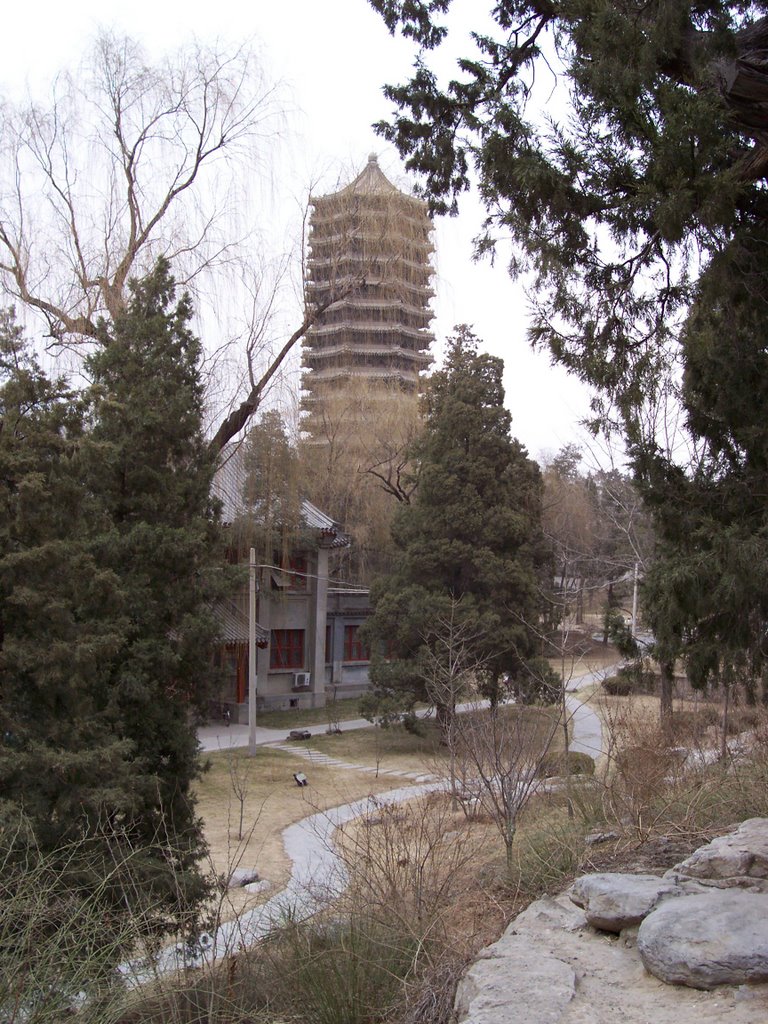
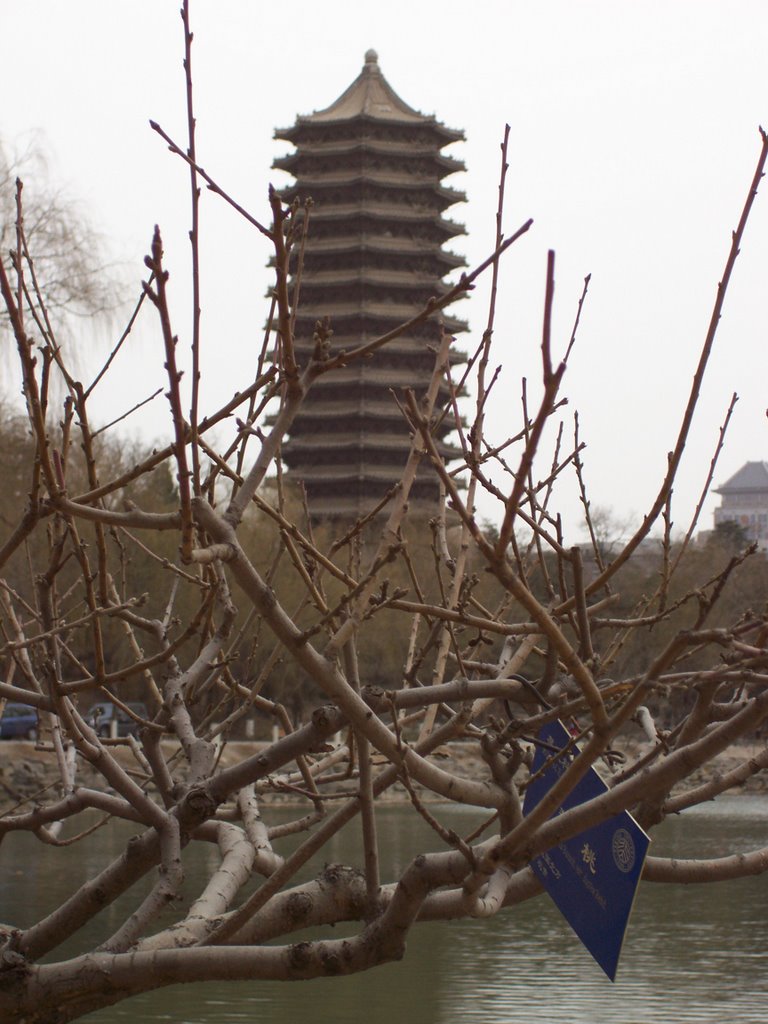
Walk around Beijing University and Garden
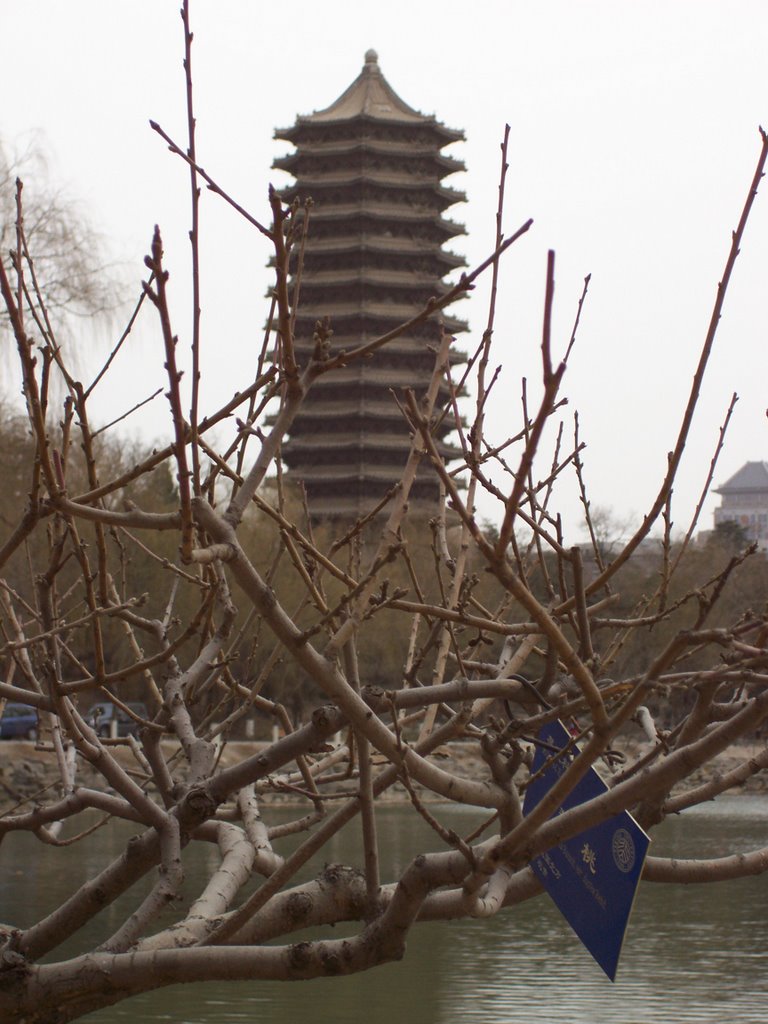
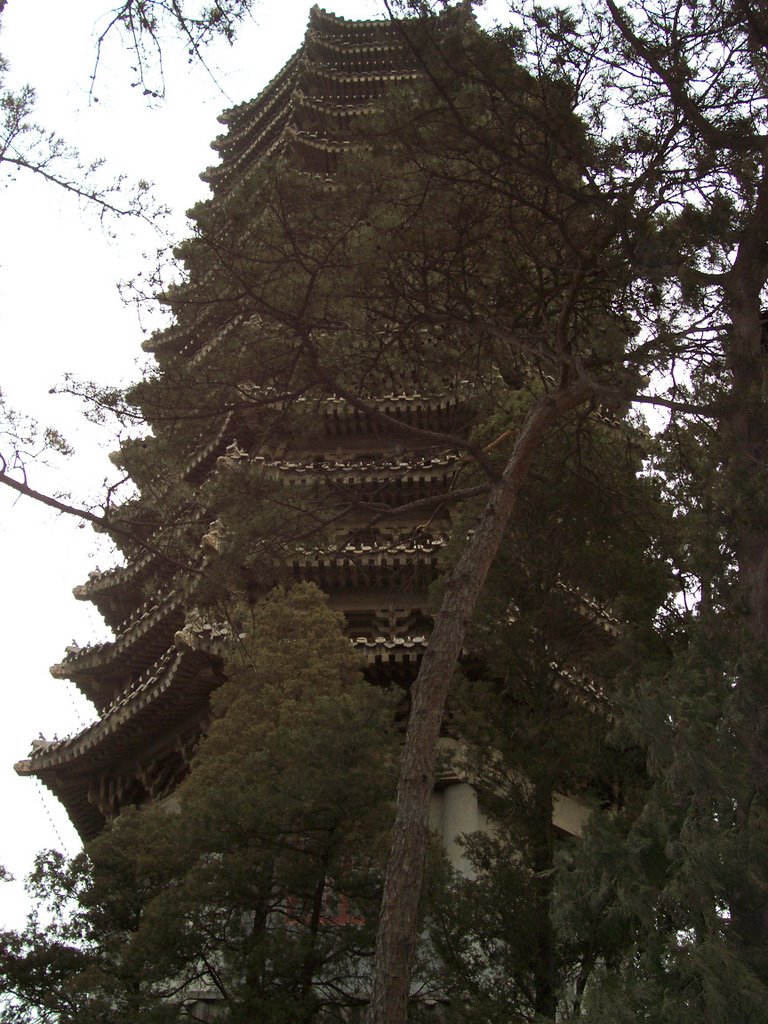 Tower Pagoda
 The Library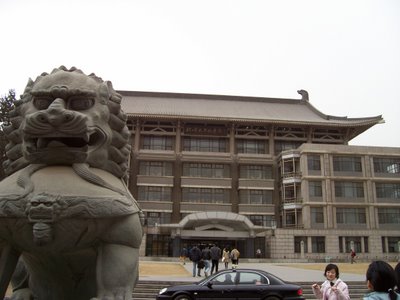
The workers quarters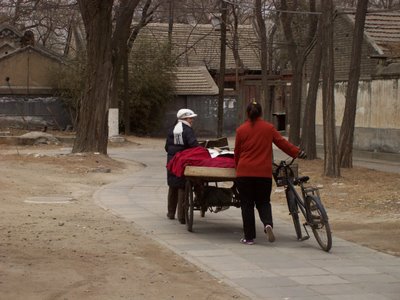
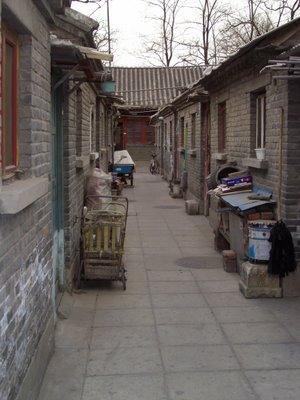
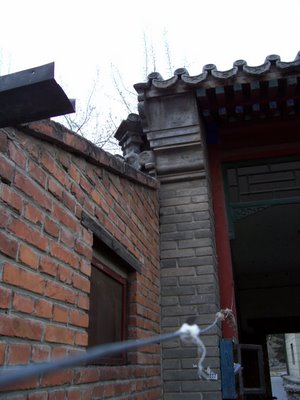
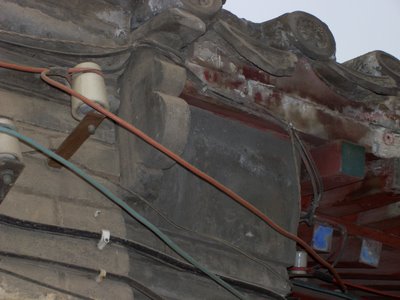
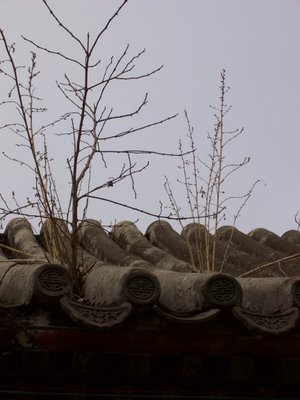
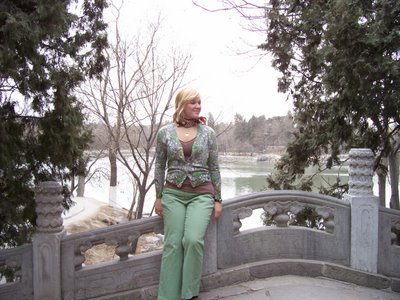
The arched foot bridge
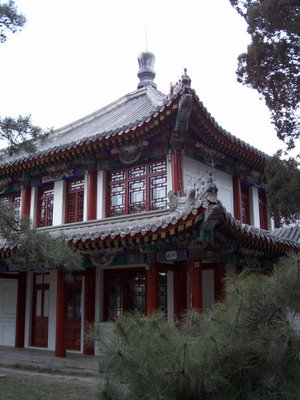
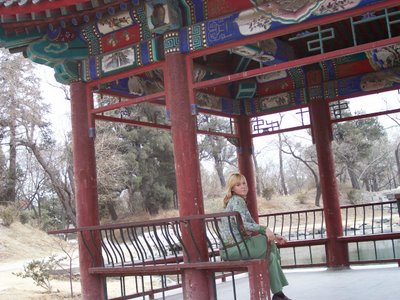
Kunqu Opera.thoughts.
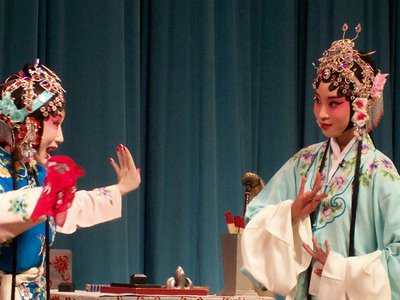
(Fingers Famously Splayed)
Haiyan and I met on Friday to enjoy a speical performance of Kunqu Opera at Beijing University. The performance was rather engaging, not because I could understand it, again only about 0.09%, but because it is that particular sensation of knowing that the music is beautiful to the ears of those that are accustomed to it, thus making it beautiful to you. And that special asian quality of hyper-flare, color, and shininess that you cannot look away from. It kept occuring to me that they might be from a different solar system. But such feelings stem from encounters with sci-fi movie extravagnaces, such as Star Wars, which were no doubt heavily influenced by this aesthetic. 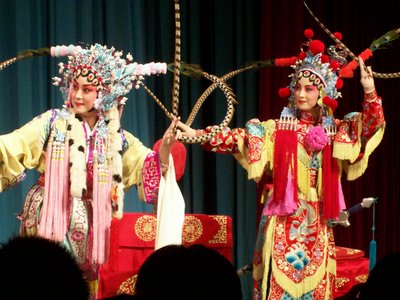 In Kunqu, much attention is focused on the hands; as their complicated comfigurations often narrate along with the warbly and unmelodic, but lovely singing. The females hands and fingers are constantly moving through expressive arrangements about their face or twirling a piece of silk or playing with their feather antennaes (as seen above).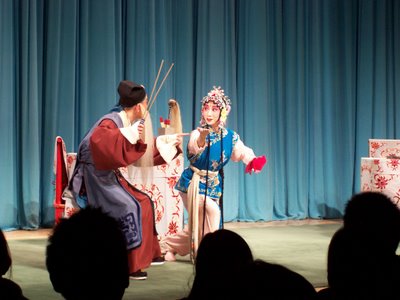
As for the music, Chinese opera seems based on a completely different math than the singing of western music. We are not accustomed to this "lack of melody." There is no decernable melodic scheme to Kunqu pieces, or at least one I could recognize. I mean there is no musical theme that is recapitulated upon again and again. We are used to some of verse- refrain-verse, or some varient there of. Even very complicated musical pieces follow this pattern to some degree as this is musical math that we find pleasurable. But this does not exist in Kunqu pieces. Its very difficult to explain, especially when I do not know much about it, but these are my impressions. So, indeed, there are no "pieces." There are but perhaps just scenes that are, by closest comparison to western opera, narrated in the fashion of a recitative, such that the sung text is vaguely guided by the rhythm of natural speech, and underneath is a aggitated musical accompaniement of drums and flutes. The voice rolls through pitches without breaking for what we call "notes" in an octave scale. Its just rolls up and down, and all crazily high to boot.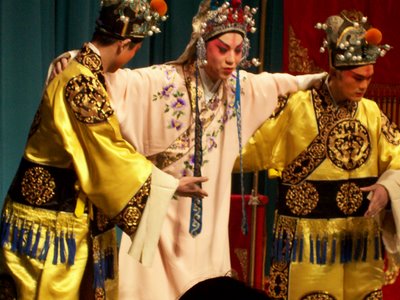
The drum is a prominent feature of the sound of Kunqu as it sort of conducts the actors movements on the stage. That is, they seem to bounce and glide and change positions at the drum's request. The sound of the drum is peculiar as it resembles the the exponentially rapid "pong" made by a ball dropping as it comes closer to the ground. There was some very lovely flute as well. The instrumentation seems very important, but the small ensemble of traditional chinese instruments was not acknowledged in the final bows.
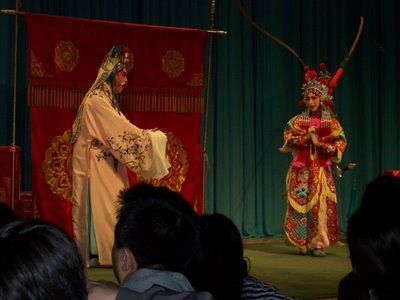 All in all, I really loved Kunqu, right down to the adorableness of the all Chinese audience (not a tourist venue) taking pictures during the performances with their cell phones (making it okay for me to take these), and yelling out randomly that they liked what they were seeing, and in general smiling through out the entire performance (I often looked around at everyone). They were hearty laughers and clappers and this type of exuberant responsiveness no doubt made the experience all the more lovely.
Thursday, March 09, 2006
Behind the Da Jie (Big Streets) lie the hutong (small alleys)

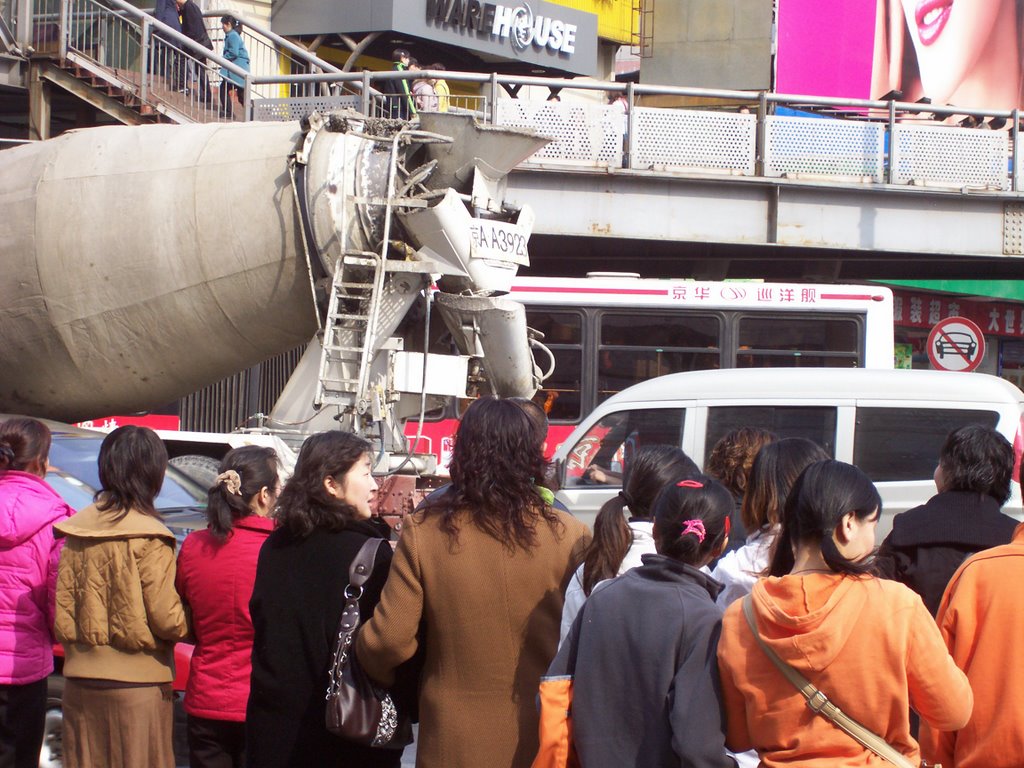 A visit yesterday to the bus, car, cement truck, bicycle, and pedestrian combat zone of the Xidan shopping district proved a failure as far as finding an english-chinese textbook, but a success as far as escaping back into the subway un-runover'd. Fortunately, I was able to find some decent looking books today back again on Wangfujing, a shopping district thankfully reserverd for pedestrians and the occasional tourist trolley. It seems as though there is no district in Beijing that is not a shopping district, besides the squeezed in spaces where people have lived for centuries, the alleys, hutongs. Below a doorway someones home.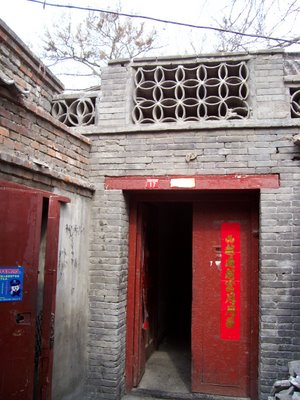
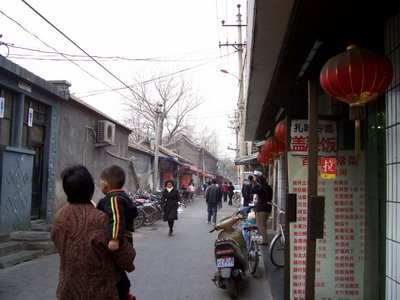 But as the hutongs are famously charming they are also famously dissapearing at a rate of 10,000 dwellings a year. I have not yet toured the hutongs, besides those dramatically scruffy ones behind the glitzy modern Wangfujing street (below) and the quieter ones flanking the Forbidden City.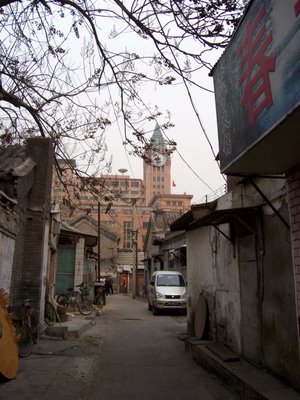
This makes up the less aromatic backside of Chanel, and Nike, and the rest of the veritable Champs-Elysee of China. Entering only the merest of entry-ways between the fancy stores...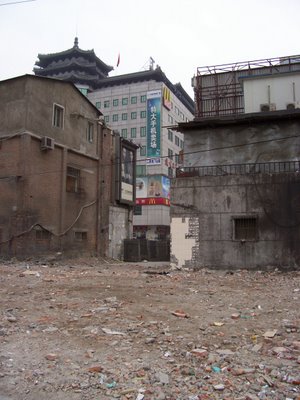 ...may find you behind a building looking out onto a space such as this: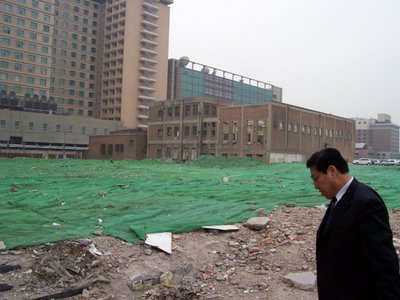
...a bulldozed lot waiting to have a multi-story department store poured into it. Formerly, no doubt, it was a hutong that had probably stood for centuries. This was the sidewalk to Snack St. Some people I passed looked dismayed to see that the buildings weren't there when they were only a week ago. They thought they were on the wrong sidewalk.
The hutongs surrounding Tian'anmen and the Forbidden City, were back in the day of the dynastic emporors, the neighborhoods of the servants and laborers of the emporor. The long alleys hutongs were created by adjacent court-yard houses, siheyuan. The hutongs were named after the families who lived there, or after storehouses that were contained in them, such as "Curtain Storehouse Alley" or "Lantern Storehouse Alley." They were also named after the workers who supplied labor and crafts to the Forbidden City such as "Big Stone Mason's Alley" or "Wet Nurse Alley." This is the famous Wangfujing Snack St., formerly a hutong, now a "snackstreet." 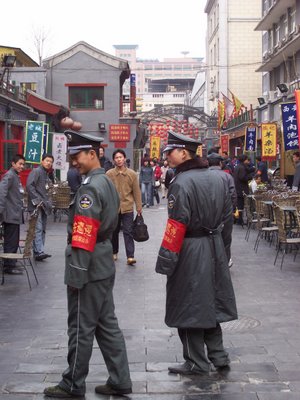
The hutongs have seen many generations, thus admittedly, most were in serious disrepair. Many hutongs still lack indoor plumbing and toilets. Though the siheyuan may have been passed down through the family, all property is still owned by the government, which probably explains the ease of their removal. However, some of the more scenically situated hutongs (next to tourist spots) are being preserved by the government. The redevelopment of Beijing's select hutongs is a process of gentrification identical to the face-lifting of American downtowns. For those who can afford to live in the charming vernacular dwelling, they must pay handsomely. I suppose its something better than razing them down completely and erecting a white-tiled tower in its place. 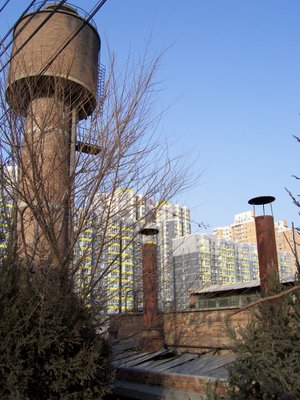
Indeed, there will be no lull in the insane level of development in Beijing. Really, impressively dizzying. It is fastly approaching, or perhaps already the glimmering (and grey?) skyscrapper landscape of the future. And if China is not short of one thing it is man-power. The creation of a clean efficient futurama creates millions of jobs. Obvisouly there are engineers, bankers, realtors, conscruction, and waitstaff, but there are way more lower-order jobs created, if not just to create jobs. The city cleaners are my favorite government employee, apart from the painfully unnoticed traffic cops, and the gaurds that sit/sleep in lawn chairs in the subway tunnels. The city cleaners are given a grungy orange bike with a hollowed drum attached for dirt and trash, and a broom made out of twigs and dried grass, and a orangish pair of pants. They "patrole" the streets and can be seen sweeping intersections after every green light. I once followed one women as she dusted every orange pay phone hood on the street. I was want to find the pay phones prettier, but it never happened.
But this process of urban employment is geogaphically baised to those areas that are undergoing rapid development. The rural areas are being gutted of its younger workforce. I have read that as you enter smaller villages you are welcomed by seniors and children because everyone else has gone to find work in the cities. Its the tale of mass urbanization and industrialization that has played out in all developped countries. Some have been better able at conserving some heritage in the process (i.e. France) but with those with more population at stake it plays out as first 1.) development at all costs, and only after dams start bursting, rivers become toxic, and no one wants to come to your country because it stinks and there are no trees and vernacular dwelllings left that 2.) the "guiding hand" actually starts guiding, if perhaps only regulating (i.e. saving some hutongs for the tourists and middle-class).
I leave you with the cold sunset I found leaving the school today. Looking out upon the gap between a white building and a karaoke (KTV) club.